The sharpest increase in three years in the repression of the exercise of freedom of expression and the press
Cuba Tightens Control:
2025 Partial Report
The largest increase in repression in three years against the exercise of freedom of expression and of the press — documented by the Cuban Institute for Freedom of Expression and the Press.
Documented
2024 (768)
Expression
Records
1. Introduction
In 2016, the Cuban Institute for Freedom of Expression and the Press (ICLEP), then four years old, began to monitor, document and write an annual thematic report on events that violate press freedom in Cuba. That same year, Reporters Without Borders took ICLEP data as a source and placed dictator Raúl Castro, then president of the country, among the 35 "Predators of Press Freedom in the World."
Since 2024, ICLEP opened its field of action and also began to record and make visible violations of freedom of expression, with the purpose of reflecting more faithfully the diversity of actors and contexts in which dissident opinion is repressed by the Cuban regime.
During 2025, ICLEP registered a total of 1188 violations, 83.8% of them corresponding to freedom of expression. The statistics respond to two realities: one, that the dictatorship does not accept any other discourse than its own, and extends its repressive halo to anyone who dissents, and two, that there are fewer and fewer journalists not affiliated with the state apparatus who work from the island. Most have had to go into exile to escape repression; although sometimes, not even beyond the borders, the harassment has stopped.
As this is the second year of documentation of violations of freedom of expression and of the press, the report presented here includes the first year-on-year comparative analysis by category of registration of the ICLEP. This approach strengthens the identification of trends, variations and transformations in the repressive patterns of the Cuban regime against the exercise of the right to inform and express opinions.
The main objective of ICLEP's 2025 Partial Report is to contribute to the understanding of the real state of freedom of expression and of the press in Cuba, to warn about the sustained deterioration of these fundamental rights and to serve as an advocacy tool for international organizations, democratic governments, civil society organizations and the media.
What this report documents is not a new phenomenon. The criminal nature of the Cuban regime dates back years. What changes from one calendar to another is its intensity, its focus and the instruments it privileges at any given moment.
2. Methodological Note
The 2025 Partial Report of the ICLEP systematizes the continuous monitoring carried out throughout the 12 months of the year on violations of freedom of expression and of the press in Cuba. The collection of information comes from a variety of verifiable sources: independent media, direct testimonies from victims and witnesses, reports from non-governmental organizations specializing in human rights, public records on social networks, and private complaints channeled through ICLEP's community media network.
Strict verification criteria were used for the selection of cases that ensure a direct relationship between the documented facts and the exercise of the right to freedom of expression or of the press, in accordance with the standards established in the Universal Declaration of Human Rights, the International Covenant on Civil and Political Rights, the Johannesburg Principles, the Johannesburg Principles, the Johannesburg Principles, the Johannesburg Principles, the Johannesburg Principles, the Declaration of Chapultepec, the Guiding Principles on Business and Human Rights, and the instruments of the Inter-American Human Rights System.
Violations are classified into six indicators: arbitrary detention; physical aggressions; attacks, threats and/or psychological aggressions; seclusion; restrictions in the digital space; and abusive use of state power. Each indicator is broken down, in turn, according to whether it affects freedom of expression or freedom of the press, according to the following operational distinction: violations of press freedom correspond to cases involving journalists, media executives or media outlets as such; Violations of freedom of expression cover anyone not identified as a journalist, including activists, opponents, ordinary citizens and political prisoners.
Validation is performed by contrasting with multiple independent sources. The monthly figures may vary in subsequent editions by incorporating corroborated cases after the end of each period. This report contains the final and updated figures for the year 2025.
The total of 1188 violations of freedom of expression and of the press documented by ICLEP during 2025 corresponds to 968 records in the organization's database. The difference between the two figures is due to a characteristic inherent to the repressive phenomenon that this report documents: in the same violation act, more than one repressive indicator can be used simultaneously.
When a person is arbitrarily detained, transferred to a police unit, subjected to intimidating interrogation, and released hours later under threat of criminal consequences if he continues to confront the regime through public expression, that single episode activates at least three indicators of the ICLEP registration system: arbitrary detention, attacks, threats and psychological attacks, and abusive use of state power. The fact is one, and as such it is recorded as a single record in the database, but it has three simultaneous violations associated with it.
This methodological criterion responds to a conscious decision: to record each episode as a coherent unit of repression, preserving the integrity of the event as it was experienced by the victim, instead of artificially fragmenting it into as many records as active indicators. Its direct statistical consequence is that the number of violations will always be equal to or greater than the number of records, never less. The difference between the two figures is, in itself, a qualitative indicator: the greater the gap between records and violations, the greater the repressive density of the documented facts.
By 2025, the ratio between 1188 violations and 968 records yields an average of 1.23 violations per record, which means that in approximately one out of every four documented episodes the regime used more than one repressive method simultaneously on the same victim and in the same event. This data confirms the integral and coordinated nature of repression in Cuba: it is not the isolated application of a control mechanism, but the calculated combination of several, aimed at producing the maximum deterrent effect with each intervention of the state apparatus.
It is worth noting that the data presented in this report do not constitute all of the events that occurred, given the restricted access to information imposed by the Cuban regime and the fear of reprisals that affects numerous victims and witnesses. This record constitutes, therefore, a verified and systematic approach to a phenomenon that has been partially but rigorously documented.
The ICLEP Partial Report 2025 is a public document. Its reproduction is authorized by any means as long as it is duly attributed.
3. 2025 registered the largest increase in repression in three years against the exercise of freedom of expression and of the press.
3.1 General Information
Cuba is a totalitarian dictatorship where the exercise of freedom of expression and of the press constitutes an act of high personal risk. In a political system that concentrates absolute power in the hands of a single party, criminalizes dissent, controls all state media, and denies pluralism, expressing critical opinion can lead to arbitrary arrests, constant surveillance, or judicial convictions.
For Cubans, the year 2025 unfolded in a context of deep economic and social crisis, characterized by prolonged blackouts, critical shortages of food and medicine, runaway inflation that eroded the purchasing power of the population, and growing citizen discontent in the face of the accelerated deterioration of living conditions. Faced with this scenario, far from addressing the structural causes of social unrest, the regime chose to intensify political control, surveillance and repression.
During 2025, the ICLEP documented a total of 1188 violations of freedom of expression and press in Cuba, consolidating the year as one of the most repressive periods of the last three years. The figure represents a significant increase compared to 2024, when 768 violations were recorded, which is equivalent to a 54.7% increase in the systematic repression exercised by the Cuban regime against citizens, journalists, activists, opponents and political prisoners.
Table 1 — Total Violations of Freedom of Expression and the Press · Year 2025
| Total Violations | Freedom of Expression | Freedom of the Press | |
|---|---|---|---|
| 2025 Figures |
1,188
|
99583.8% of total
|
19316.2% of total
|
| vs. 2024 | +54.7% vs. 768 | +107.7% vs. 479 | −33.2% vs. 289 |
Source: Cuban Institute for Freedom of Expression and the Press (ICLEP). Final data, year 2025.
The monthly average of violations reached 99 assaults, with an all-time high in July, when 184 cases were reported.
Table 2 — Monthly Distribution of Documented Violations · 2024–2025 Comparative
| Month | 2024 | 2025 | Variation (%) |
|---|---|---|---|
| January | 21 | 61 | +190.5% |
| February | 50 | 51 | +2.0% |
| March | 71 | 102 | +43.7% |
| April | 82 | 122 | +48.8% |
| May | 90 | 108 | +20.0% |
| June | 42 | 153 | +264.3% |
| July ⚑ Peak month | 99 | 184 | +85.9% |
| August | 37 | 75 | +102.7% |
| September | 42 | 75 | +78.6% |
| October | 81 | 64 | −21.0% |
| November | 65 | 100 | +53.8% |
| December | 88 | 93 | +5.7% |
| TOTAL | 768 | 1,188 | +54.7% |
Source: ICLEP. ⚑ July 2025 represents the historical peak of the last three years, coinciding with the 4th anniversary of July 11, 2021 (11J).
Source: Cuban Institute for Freedom of Expression and the Press (ICLEP). Final data, year 2025.
The month-to-month behavior shows a structural pattern of planned repression that can be divided into three clearly differentiated phases:
Phase 1: Moderate start (January-February)
The year began with relatively contained levels, if compared to the figures from March onwards. In January, 61 violations were documented and in February 51, those being the lowest records in all of 2025. However, such behavior should not be interpreted as an act of tolerance or openness, but as part of a repressive cycle that historically shows moderation in the first months of the year, consistent with the pattern observed in 2024.
Phase 2: Sustained escalation (March-July)
March marked the definitive turning point of the year, with 102 violations, which represented an increase of 100% compared to the previous month. The increase coincided with the beginning of a new repressive escalation by the regime against the opposition organization Damas de
Blanco (Ladies in White), with the aim of preventing him from attending mass to pray for freedom of political prisoners.
From March onwards, a sustained and uninterrupted upward cycle began:
- April: 122 violations (+19.6% vs March)
- May: 108 violations (+20 % vs April)
- June: 153 violations (+15.4 % vs May)
- July: 184 violations (+20.3 % vs June) — historical record of the last three years.
This growth confirms a deliberate and programmed intensification of repression. July established the absolute peak of the year, coinciding with the fourth anniversary of July 11, 2021 (11J), a date that the regime considers a symbol of popular defiance of its authority and that motivated massive preventive repressive operations throughout the country. ICLEP documented that 39 people, including 13 journalists, faced between 9 and 11 July, illegal summonses, arbitrary detentions, restrictions on movement, permanent surveillance and threats against them.
Phase 3: Tactical modulation and rebound (August-December)
As happened in 2024, after the repressive peaks of the first half of the year, as of August the aggressions decreased. The eighth month of the year registered an abrupt decrease to 75 violations, equivalent to 59.2% of the level reached in July. The fall, however, was not due to an improvement in the climate of freedoms, but to a tactical pause by the regime to reduce the international visibility of the repression after five months of maximum intensity.
The modulation was temporary. September maintained the same level (75 violations), in October it fell to 64, but in November 100 events were counted and in December 93, figures much higher than those recorded at the beginning of the year.
ICLEP warns that this pattern, already identified in 2024, confirms that the regime adjusts the visible intensity of repression according to the political context and international scrutiny, but never abandons its fundamental objective of totalitarian control. In both years, the trend shows an increasingly high repressive floor.
3.2 Behavior of the indicators
The ICLEP's records of violations of freedom of expression and of the press are based on six indicators that allow us to characterize the methods used by the repressive state apparatus against free opinion: 1- arbitrary detention, 2- attacks, threats and/or psychological aggressions, 3- abusive use of state power, 4- restrictions on the digital space, 5- physical aggression, and 6- imprisonment. Each is more than a classification category: it corresponds to a form of repression with a specific logic, function, and social effect.
Table 3 — Violations by Indicator and Month, with Breakdown by Type of Right · Year 2025
| Month | Arbitrary Detention |
Attacks, Threats & Psych. Aggression |
Abusive Use of State Power |
Restrictions Digital Space |
Physical Aggressions |
Imprisonment | Monthly Total |
|---|---|---|---|---|---|---|---|
| January | 13 | 21 | 22 | 2 | 3 | 0 | 61 |
| February | 14 | 14 | 14 | 2 | 3 | 4 | 51 |
| March | 59 | 25 | 13 | 2 | 2 | 1 | 102 |
| April | 59 | 35 | 23 | 2 | 2 | 1 | 122 |
| May | 40 | 43 | 19 | 3 | 2 | 1 | 108 |
| June | 50 | 50 | 44 | 0 | 7 | 2 | 153 |
| July ⚑ | 75 | 70 | 28 | 4 | 3 | 4 | 184 |
| August | 15 | 29 | 19 | 5 | 5 | 2 | 75 |
| September | 14 | 18 | 33 | 7 | 1 | 2 | 75 |
| October | 11 | 26 | 22 | 2 | 2 | 1 | 64 |
| November | 12 | 64 | 20 | 3 | 1 | 0 | 100 |
| December | 24 | 40 | 19 | 9 | 1 | 0 | 93 |
| TOTAL 2025 | 386 | 435 | 276 | 41 | 32 | 18 | 1,188 |
| Freedom of Expression (FE) | 347 | 311 | 262 | 28 | 30 | 17 | 995 |
| % of indicator | 89.9% | 71.5% | 94.9% | 68.3% | 93.8% | 94.4% | 83.8% |
| Freedom of the Press (FP) | 39 | 124 | 14 | 13 | 2 | 1 | 193 |
| % of indicator | 10.1% | 28.5% | 5.1% | 31.7% | 6.3% | 5.6% | 16.2% |
Source: ICLEP. Final data 2025. · ⚑ July highlighted: highest monthly total (184). · Values in bold indicate the highest monthly figure per indicator. · FE = violations of freedom of expression; FP = violations of freedom of the press.
Table 4 — Distribution of Violations by Indicator · 2024–2025 Comparative
| Indicator | 2024 | 2024 % | 2025 | 2025 % | Variation |
|---|---|---|---|---|---|
| Arbitrary Detention | 150 | 19.5% | 386 | 32.5% | +157.3% |
| Attacks, Threats & Psych. Aggressions | 267 | 34.8% | 435 | 36.6% | +62.9% |
| Abusive Use of State Power | 160 | 20.8% | 276 | 23.2% | +72.5% |
| Restrictions in the Digital Space | 141 | 18.4% | 41 | 3.5% | −70.9% |
| Physical Aggressions | 21 | 2.7% | 32 | 2.7% | +52.4% |
| Imprisonment | 29 | 3.8% | 18 | 1.5% | −37.9% |
| TOTAL | 768 | 100% | 1,188 | 100% | +54.7% |
Source: ICLEP. Final data, years 2024 and 2025.
Source: ICLEP. Final data, year 2025.
3.2.1 Attacks, threats and/or psychological aggressions: 435 (311 against freedom of expression and 124 against freedom of the press).
This indicator, which includes actions such as verbal threats, psychological harassment, intimidation of family members, surveillance, provocations organized by groups related to the regime, summons to interrogation, financial asphyxiation, and sustained emotional pressure, was consolidated as the most used repressive method during 2025.
The preponderance of this mechanism responds to its deterrent effectiveness and its low political cost: the regime generates fear, self-censorship and social isolation without the need for mass arrests that increase the international visibility of repression. Prolonged psychological harassment serves the objective of breaking the victims' will to resist and sending intimidating messages to their close environments.
The months with the highest incidence of this type of violation were July, with 70 cases, November with 64, and June with 50. In addition, in the months of May, August, October and December it was the most widely used method to repress freedom of expression and of the press in Cuba.
When at the end of May the communications monopoly ETECSA announced the increase in the prices of mobile data service, a wave of discontent was unleashed in the Cuban university sector, and several faculties organized teaching strikes. The reaction of the regime was not long in coming. In an attempt to stop the student mobilization, the authorities deployed a repressive offensive: they pressured the students with threats of expulsion, subjected them to interrogations, warned them of the possibility of being taken to prison, searched their mobile phones and forced them to delete everything related to the protests, pressured them to delete WhatsApp groups that they used as informal communication channels, and they even visited them in their homes and issued warnings to their parents.
At the same time, the pro-government media and social media profiles related to the dictatorship presented the students' claims as false, denied the calls for the strike and blamed the opposition and the independent press for the circulation of false messages. This crude strategy was dismantled by the publication of testimonies of the university students themselves and by leaked videos of the exchanges that the teaching and party authorities and State Security held with them.
In these events, it was impossible to define a number of people involved, which would have skyrocketed the number of ordinary citizens registered in 2025 as victims of attacks, threats and/or psychological aggressions. 1
One group that was widely repressed were activists, who accounted for 127 of the violations of freedom of expression recorded within this indicator. Throughout the year, they were subjected to constant surveillance, harassment, summonses and police interrogations, with the Ladies in White being one of the most affected. In fact, the organization was the second group of people whose right to express themselves was violated the most times during 2025, with 181 documented reports, in 74 of which there was an act of threat or psychological aggression. 2
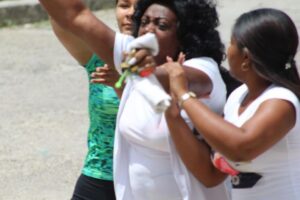
Arrest of the Lady in White Berta Soler on June 8, 2025. Photo taken from the Facebook profile of her husband, the opponent Ángel Moya.
It is also worth mentioning the case of Wilber Aguilar Bravo, father of political prisoner Walnier Aguilar, who has been kept under constant siege by the political police for raising his voice in favor of the freedom of his son and all political prisoners. 3
Among the cases of violations of press freedom documented as attacks, threats and/or psychological aggressions (124 in total), was the defamatory campaign against the independent media El Toque, with the aim of undermining its credibility and falsely linking it to the rise of the dollar in the informal market.
At the end of October, publications began to circulate simultaneously on Facebook and WhatsApp with identical messages, most of them from newly created accounts and with clear signs of being fake profiles, which repeated slogans such as "No to TOQUE", without accompanying arguments or context.
An episode of harassment abroad was added to the digital offensive. On November 5, in Mexico City, a group of individuals staged an act of repudiation against José Jasán Nieves, director of the media, while he was participating in the Latam Festival, organized by the Centro Cultural España. The attackers showed up with a sign and a megaphone, repeating false accusations and slogans identical to those spread by Havana government spokesmen, calling Nieves and the outlet "mercenaries" and "manipulators."
A Nov. 12 report on Cuba's state-run television program Razones attempted to link El Toque to an alleged "currency trafficking scheme" and "tax evasion" in Cuba, alleging that it operates as part of a U.S.-funded "comprehensive economic warfare program."
The audiovisual material, released without providing verifiable evidence, described the independent media as a "subversive instrument" and "agent of financial terrorism." He alleged that the daily publication of the Representative Rate of the Informal Market (TRMI) would be part of a "speculative maneuver" aimed at "depressing the income of the population" and generating "financial panic." 4
Journalist Yunia Figueredo was also the victim of an escalation of repression, after taking over the direction of the community media outlet ICLEP Amanecer Habanero. Yunia was the target of a growing campaign of harassment and intimidation by State Security, including permanent surveillance, illegal summonses, verbal threats and psychological pressure against her family environment. She and her husband, fellow journalist Frank Correa, were warned of an alleged investigation opened against them for the alleged crime of "pre-criminal social dangerousness," a legal figure frequently used in Cuba to criminalize dissent.

Yunia Figueredo. Photo taken from her Facebook profile.
Yunia Figueredo's situation was denounced by the Committee to Protect Journalists (CPJ). The organization called on the Cuban regime to end the harassment against her and her husband, and allow them to continue their journalistic work. 5
Another representative case of the sustained repression against independent journalism is that of Camila Acosta, who accumulates 12 records of intimidating surveillance throughout 2025. The events were distributed over the twelve months in three recurrent contexts: dates of high symbolic value for both civil society and the regime, moments of journalistic coverage of sensitive events or attempts to participate in them, and episodes of systematic harassment directly associated with his status as an independent journalist. Permanent surveillance of the home as a repressive method fulfils a precise function: it does not require arrest or judicial process, it does not leave verifiable physical marks and, however, it produces an effect of continuous coercion that conditions each professional decision of the victim. Knowing that there are agents stationed in front of her door every time something happens that the regime considers sensitive is, in itself, an unequivocal message: the state observes her, knows her movements and can act at any time. The fact that this message has been repeated twelve times in a single year about the same person confirms that the intimidating surveillance was not a one-off measure in the case of Camila Acosta but a policy of deliberate and sustained harassment against her journalistic practice. 6
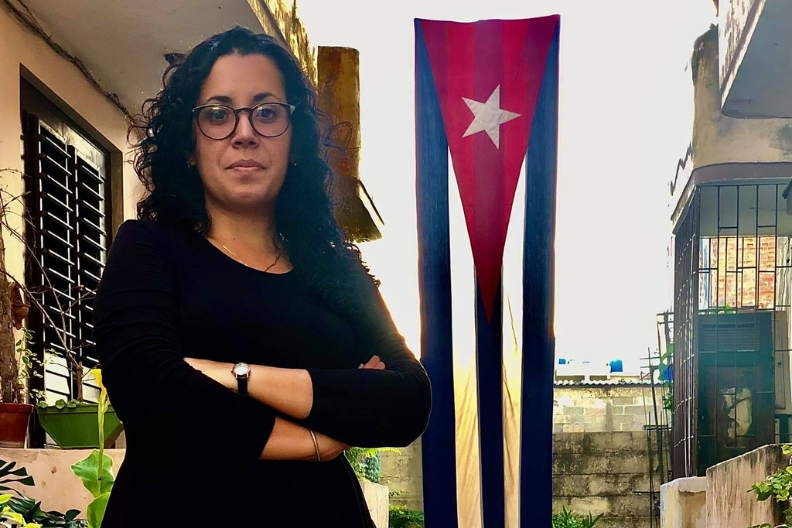
Independent journalist Camila Acosta. Photo taken from her Facebook profile.
The behavior observed during 2025 confirms that attacks, threats and/or psychological aggressions constitute a central pillar of the repressive strategy of the Cuban State, aimed at generating fear, isolating critical voices and promoting self-censorship. The systematicity of these practices shows a pattern of sustained intimidation that transcends the direct victims and affects their environments, consolidating a climate of permanent pressure on those who exercise their right to express themselves.
In this context, psychological harassment is reaffirmed as an effective control mechanism that allows the regime to limit public debate and contain dissent without necessarily resorting to more visible forms of repression, thus maintaining a restrictive environment for the exercise of freedom of expression and of the press in the country.
3.2.2 Arbitrary detentions: 386 (347 against freedom of expression and 39 against freedom of the press).
Arbitrary detentions represented the second most used method, accounting for 32.49% of documented cases. This indicator includes arrests without warrants, temporary detentions without charge, illegal summons to police units, and brief "disappearances" intended to prevent participation in specific events or journalistic coverage of sensitive situations.
July peaked with 75 arbitrary detentions, followed by March and April, with 59 each, and June with 50. The figures show that, in the months of greatest repression, arbitrary detention was the method most used by the dictatorship to silence them.
Arbitrary detention serves a double function: to temporarily neutralize critical people in moments of transcendence for the tyranny, and to instill exemplary fear in the rest of society. It is no coincidence that July and May are the months with the highest numbers. In May, key dates such as International Workers' Day, International Press Freedom Day and the anniversary of the founding of the Republic, led to strong repressive operations, especially prohibitions on leaving homes under threat of arrest to independent journalists, activists and opponents. The goal? On the one hand, to prevent "unscripted acts" from occurring in the regime's political celebrations; on the other, to avoid meetings or demonstrations of activists on symbolic dates.
Under the latter assumption, in the month of July, on the 9th, 10th and 11th, the dictatorship used house arrest as a method to repress any possible commemorative action for the 2021 demonstrations, unprecedented in Cuban history.
He did so, among other contexts, for the anniversary of the Emilia Project, in January, for the anniversary of another milestone of social protest in Cuba: the Maleconazo, in August, and for International Human Rights Day, in December.
The arbitrary detention was also widely used by the regime in its eagerness to prevent the contact of members of Cuban civil society with the charge d'affaires of the U.S. embassy in Havana, Mike Hammer, during his tour of several provinces of the country to dialogue with activists, peaceful opponents and relatives of political prisoners. and to take an interest in the situation on the island. In Holguín, on May 18, activist Idelsys Pupo Labrada, mother of 11J political prisoner William Leyva Pupo, was violently detained by police and forced into a patrol car to prevent her from attending a meeting with Hammer. The next day, in Puerto Padre, Las Tunas, a strong police operation was deployed at the home of activist Vladimir Martín Castellanos, and both he and his wife were detained and held incommunicado to prevent them from attending a conversation with the diplomat. Also in Puerto Padre, former political prisoner Ezequiel Morales Carmenate denounced surveillance outside his home by repressors of the political police. 7
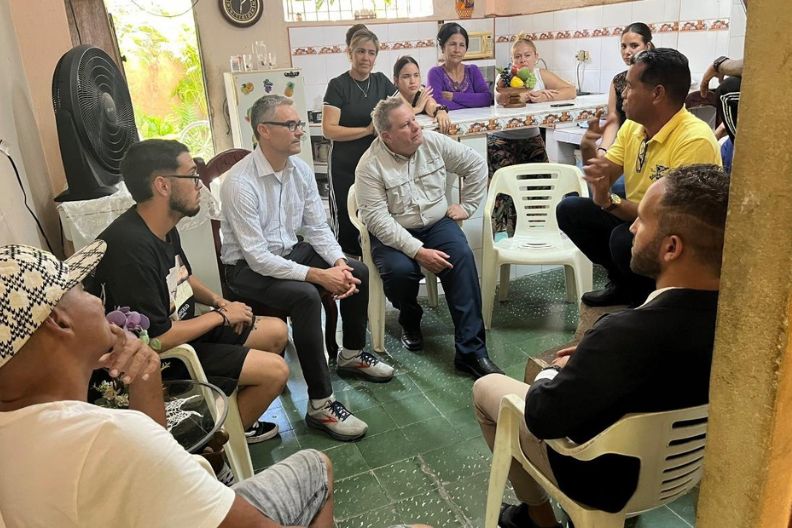
Mike Hammer during a visit to Palma Soriano. Photo: X / U.S. Embassy in Cuba.
Berta Soler, leader of the Ladies in White, and her husband, the opposition Ángel Moya, have been under investigation since April for the alleged crimes of attacking the constitutional order, independence and sovereignty of Cuba, after meeting with Hammer.
Soler has been subjected to several arbitrary detentions during the year. In the month of March alone, she was detained for five consecutive Sundays, in what constituted a clear violation of the right to freedom of expression and religion, as she was prevented from participating in Mass to pray and ask for the freedom of Cuban political prisoners. During the arrest on 30 March, Berta was placed in a cell with a common prisoner who threatened to kill her, in the presence of State Security agents who did not intervene, indicating a possible deliberate action to intimidate her and silence her voice.
Peaceful protest was another action that the regime repressed through arbitrary detentions. The writer and journalist Jorge Fernández Era was detained for three consecutive months (June, July and August), when he was preparing to participate in the sustained civic action that academics and intellectuals carry out every day 18 in favor of change in Cuba. During the June arrest, Era faced shouts, insults and threats of being taken to Villa Marista (a center for criminal instruction and torture of the political police), in addition to receiving a warning that he refused to sign. In June, he was taken to the Zanja police unit, where he was physically assaulted by a lieutenant colonel and subjected to death threats, including covert methods such as causing accidents or poisoning. Medical images certified visible injuries to the face, ear and other parts of the body, but the police refused to process their complaint claiming that the damage was "minor".
In August, Fernández Era was arrested again and handcuffed with such force that it caused a bleeding wound on his wrist. He was also subjected to prolonged interrogation without legal grounds and his identity card was withheld. 8
The behavior recorded during 2025 confirms that arbitrary detention continues to be one of the most effective instruments of the repressive apparatus to control civic space and neutralize any manifestation of dissent. Its repeated use, especially on symbolic dates and contexts of possible social mobilization, shows a strategy aimed not only at preventing concrete actions, but also at establishing a climate of permanent fear that limits citizen participation and the exercise of independent journalism.
The magnitude and systematicity of this indicator reflect that arbitrary deprivation of liberty remains a normalized practice within the model of state control, used selectively and preventively to restrict fundamental rights and send a dissuasive message to society as a whole. As long as this pattern persists, freedom of expression and of the press in Cuba will continue to be conditioned by the constant threat of arrest as a mechanism of silencing.
3.2.3 Abusive use of state power: 276 (262 against freedom of expression and 14 against freedom of the press).
In 2025, ICLEP recorded 276 acts of abuse of state power, committed to punish or silence critics through fabricated criminal prosecutions, rigged trials, disproportionate sentencing, and the systematic violation of the prison rights of political prisoners and prisoners of conscience.
June saw the highest growth in this type of violation, with 44 cases representing a 131.6% increase over May (19 cases). This increase is the clearest sign of the transition from reactive and street repression to a planned, "legalized" and less visible repression.
This tactical reconfiguration confirms that the regime not only detains or attacks, but also instrumentalizes the law, justice and public institutions as tools of punishment and harassment.
Among the documented cases is the sentence to four years and six months in prison against Julio César Duque de Estrada Ferrer for filming a queue to purchase liquefied gas9, as well as the repeated refusal of the prison authorities to allow the Lady in White Sonia Álvarez to visit her daughter, political prisoner Sayli Navarro, for the simple fact of wearing white, in open violation of basic rights. 10
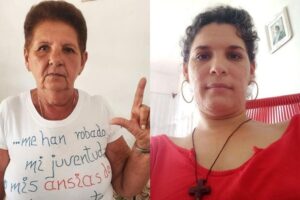
Sonia Álvarez and her daughter Saily Navarro. Photos taken from Félix Navarro's social networks.
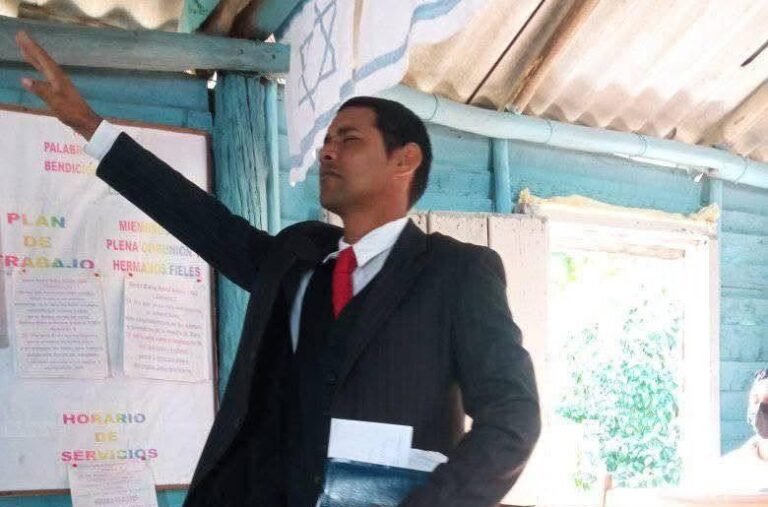
Judicial proceedings were also registered against evangelical pastors Luis Guillermo Borjas and Roxana Rojas after invoking religious reasons during a military trial against their son11; as well as the ten-year prison sentence for activist Alexander Verdecia Rodríguez for his social media posts, 12
In the same pattern is inserted the sentence to five years in prison against the independent artist Fernando Almenares Rivera, known as Nando Obdc, for the alleged crime of "propaganda against the constitutional order", after placing posters with messages such as "We want changes now" and "Cuba First in the streets for human rights". The sentence, issued by the Chamber of Crimes against State Security, described these expressions as attempts to provoke social disorder. In addition to the deprivation of liberty, the court imposed the confiscation of personal property, including his mobile phone and cash, the deprivation of public rights and a ban on leaving the country. During the process, the authorities used as incriminating elements his relationship with media outlets and independent civil society organizations such as Radio Martí, Cubalex and Diario de Cuba, as well as his participation in artistic initiatives linked to the promotion of rights, evidencing the criminalization of links with information and civic spaces not controlled by the State. 13
These facts illustrate how the Cuban regime systematically resorts to the manipulation of the legal framework and the discretionary use of its institutions to legitimize repression, punish dissent and send an exemplary message to society as a whole, consolidating a model of control that combines legal coercion with political sanctions.
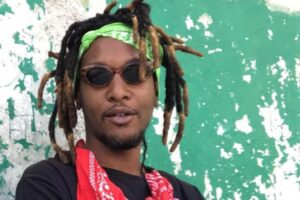
Fernando Almenares, Nando Obdc. Photo taken from his Facebook profile.
As part of the abusive use of state power, several cases of prison rights violations were recorded during 2025. The regime punished with transfer to punishment cells, physical aggression, suspension of telephone calls, visits and religious assistance, denial of medical attention, and other repressive actions, the complaints made by political prisoners, either of their situation of confinement or of the conditions in prisons.
In the area of press freedom, the abusive use of state power was also manifested through administrative, judicial, and penitentiary measures aimed at punishing or limiting the practice of journalism and critical thinking. During the year, actions were documented against independent journalist Orlidia Barceló Pérez, director of the ICLEP community media El Espirituano, who was detained at the Viru Viru international airport in Bolivia, after being accused of carrying an alleged false document and being at risk of deportation to Cuba, where she would face reprisals for her informative work; a situation aggravated by the refusal of the Cuban consulate to provide assistance or recognize his right to request asylum. 14
Likewise, journalist Yeris Curbelo Aguilera, imprisoned after covering the May 2023 protests in the town of Caimanera, was subjected to punitive measures within the prison system, such as the arbitrary denial of access to correctional work – a right recognized to other inmates – in what constitutes an extension of the punishment for his journalistic activity. 15
Also in prison, the writer and political prisoner José Gabriel Barrenechea was sanctioned with a ban on receiving books or reading materials, a measure that restricts his access to information and evidences the use of the prison regime as a tool to pressure critical voices. Similarly, his writ of habeas corpus was denied and in September the Provincial Court of Villa Clara concluded the trial against him, in which he faced a prosecutor's request for 6 years in prison for having demonstrated on November 7, 2024 in a peaceful protest against the blackouts in the municipality of Encrucijada. 16
On the other hand, historian and researcher Alexander Hall Lujardo remained under a ban on leaving the country and under pressure to incriminate himself, in a context in which the authorities linked the measure to his academic work and his collaboration with the independent media El Toque, illustrating how administrative and migratory mechanisms are used to hinder independent intellectual and journalistic work. 17
Together, these cases show a sustained pattern of instrumentalization of legal, administrative, and penitentiary structures to restrict fundamental rights and strengthen mechanisms of control over those who practice journalism, activism, or public criticism, which allows us to measure the structural scope of this repressive method.

Orlidia Barceló, José Gabriel Barrenechea and Yeros Curbelo.
Photos taken from social networks.
The analysis of the abusive use of state power during 2025 confirms that the Cuban regime insists on the strategy of dressing repression in legality, transferring punishment from the police to the judicial and administrative spheres with the purpose of conferring the appearance of legitimacy to practices that violate fundamental rights. The manipulation of criminal proceedings, the discretionary application of sanctions, migratory restrictions and the use of the prison system as a space for coercion reflect a model of control that transcends direct persecution and is inserted into the ordinary functioning of institutions.
3.2.4 Restrictions in the digital space: 41 (28 against freedom of expression and 13 against freedom of the press).
During 2025, ICLEP documented 41 cases of technological control, either through selective internet shutdowns, blocking of social media accounts, DDoS-type cyberattacks against independent media, surveillance of private communications, and limitations on access to digital platforms.
One of the emblematic cases was the cyberattack against the independent media outlet El Toque on December 17, which caused the intermittent crash of its web portal through a DDoS (denial of service) attack. The media denounced that it was not a technical failure but a deliberate attempt to prevent access to information, coinciding with official smear campaigns against its journalists for the daily publication of the Representative Rate of the Informal Foreign Exchange Market. 18
Another relevant case, also in December, was the temporary blocking of the WhatsApp account of Cuban-American journalist Mario J. Pentón, after revealing information about privileged diplomatic trips by members of the Castro family 19.
In April, the regime proceeded to cut off Internet service throughout the Altamira neighborhood, in the city of Santiago de Cuba, in the midst of a visit by journalists from the international agency Reuters to opposition leader José Daniel Ferrer García at the headquarters of the Patriotic Union of Cuba (UNPACU).
In June, the decision of the state monopoly ETECSA to abruptly increase mobile internet rates constituted in itself a violation of the right to free access to the internet, by imposing an economic barrier that severely limited the ability of thousands of Cubans to communicate and express themselves, and that involved other violations, such as threats and interrogations. especially young university students who protested against the measure.
In October, content creator Anna Sofía Benítez Silvente, 20, suffered a selective connectivity block. According to his complaint, on the 16th of that month he suddenly lost access to calls and mobile data, a situation that was repeated several days later. The service was listed as "active" in ETECSA's system, but the interruptions coincided precisely with its critical publications on the Cuban reality. When he went to an office of the state company, he received no explanation and was required to hand over his phone for a supposed technical review, which he refused. The case is a clear example of how the telecommunications monopoly acts as an instrument of selective punishment, turning connectivity into a privilege conditioned on political obedience. 20
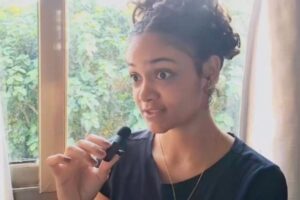
Anna Sofía Benítez Silvente. Photo taken from her Facebook profile.
3.2.5 Physical assaults: 32 (30 against freedom of expression and 2 against freedom of the press)
Although with lower figures compared to other indicators, the 32 physical attacks recorded by ICLEP during 2025, confirm that the regime maintains the recourse of direct violence against those who dare to break the imposed siege of silence.
Of the events recorded, only two were related to the exercise of press freedom. In both cases, the victim was journalist and writer Jorge Fernández Era, who during some of the arbitrary detentions he suffered when he tried to participate in acts of civic protest, suffered beatings and extreme immobilization measures.
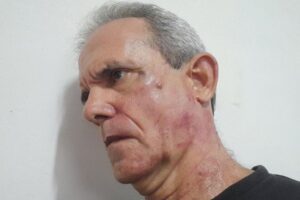
Jorge Fernández It was with obvious signs of physical aggression. Photo taken from his Facebook profile.
In general, the documented physical attacks show a recurrent pattern in which violence occurs, in most cases, during arbitrary detentions or in the context of peaceful protest actions. For example, activist Yamilka Lafita suffered a grade two sprain in her foot after being pushed by officers while being forcibly transferred to a police unit in Havana 21 while Sunamis Quintero García, mother of two children aged one and five, was beaten by agents during her arrest in the middle of a demonstration over the prolonged power cuts in the municipality of Guanabacoa. 22
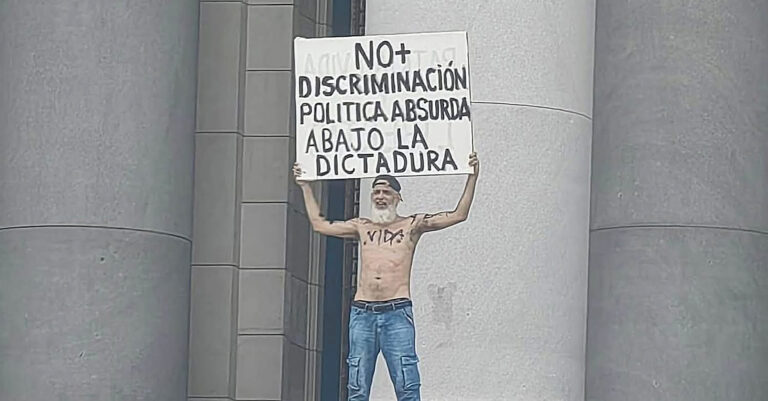
For his part, the young Leonardo Romero Negrín was beaten when he was arrested for carrying out a peaceful protest in the Central Park of Havana 23, while the elderly Héctor Julio Cedeño, 71, was violently arrested for expressing his disagreement with a poster critical of the country's situation 24. Cedeño sells candy to survive. he is "constantly harassed by inspectors and agents of State Security." The old man carries a sign demanding the end of the dictatorship and when they try to confiscate his merchandise or arrest him, he takes it out as a form of protest. These episodes reflect the willingness of the repressive forces to use physical force as a mechanism of immediate punishment in the face of public expressions of discontent.
Of particular gravity is the case of Jenni M. Taboada, mother of political prisoner Duannis León Taboada, who was subjected to sexual assault and psychological torture during an interrogation at the El Capri police unit, in Arroyo Naranjo, in retaliation for seeking international support for her son. During the interrogation, State Security agents humiliated her by calling her a "bad mother" for meeting with diplomatic personnel, and when she reacted to the insults, several repressors violently restrained her. In the midst of the struggle, an agent identified as "Luisito" invaded her physical integrity through non-consensual sexual contact, in an act of abuse that evidences the use of violence and humiliation as tools to emotionally break relatives of political prisoners. This episode illustrates the extent to which repression can take degrading forms that are deeply harmful to human dignity. 25
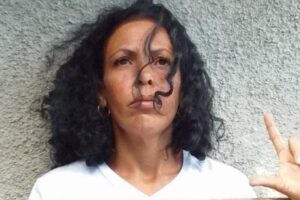
Jenni M. Taboada. Photo taken from her Facebook profile.
Another pattern resulting from the analysis of the physical aggressions committed by the regime during 2025 against the exercise of freedom of expression is that political prisoners are the most recurrent victims. Of the total number of records, 16 belong to political prisoners.
During June and July, José Daniel Ferrer, then held in Mar Verde prison, suffered brutal beatings and torture for several consecutive days, at the hands of prison officials and common inmates used as a repressive instrument by the regime's prison authorities.
In addition to being savagely beaten with fists, kicks, and blunt objects on the head, abdomen, back, legs, and arms, Ferrer was subjected to other forms of torture: his fingers were twisted and his wrists were twisted forcefully until they were almost fractured; his nose and face were squeezed to force him to open his mouth while another repressor held him by the neck in an attempt to force him to ingest milk. On one occasion, the brutality was such that he ended up defecating on himself. 26
Other cases reveal the use of physical aggression as punishment for protest actions inside the prison: Eider Frómeta Allen, for example, was beaten and dragged to his detachment by prison officers from the Boniato prison, for demanding the suspension of family visits 27. In the Combinado del Este Prison, political prisoner Walfrido Rodríguez Piloto was brutally beaten for shouting "Patria y Vida!" (Homeland and Life!), as a form of protest against the sudden interruption of his family visit 28. In the Ariza prison, the political prisoner Idalberto Reyes Saroza was violently beaten by the head of the prison's Interior Order, to, according to him, force him to "stop subverting those condemned there." 29
Taken together, the documented facts confirm that physical aggression continues to be a resource available within the repressive repertoire of the State, used mainly in contexts of arbitrary detentions, peaceful protests and within the prison system, with special cruelty against political prisoners and visible activists. Although numerically inferior to other forms of violation, it is evident that the regime continues to be willing to use direct violence as a mechanism of punishment, intimidation and control over the exercise of fundamental rights.
3.2.6 Imprisonment:18 (17 against freedom of expression and 1 against freedom of the press)
The 18 detentions documented by ICLEP in 2025 correspond to people who entered the prison system during the year for exercising their right to freedom of expression, representing 1.5% of the total violations. 94.4% of the cases affected freedom of expression. The only case registered as a violation of press freedom was that of independent journalist and activist Ángel Cuza, transferred to the maximum security prison of Combinado del Este, in Havana, where he remained in provisional detention on charges of illegal possession of weapons and other alleged crimes against State Security. Cuza had been intercepted on July 25 by agents of the regime when he was on his way to visit a friend in Havana, in the midst of the operations deployed on the occasion of July 26, a symbolic date for the regime. During a search, the officers found an old bullet that he had been carrying as a spiritual amulet for years. which was used as a pretext for his arrest. Ana Castillo, mother of his daughter, confirmed on July 30 to Martí Noticias that Cuza managed to communicate with her by phone from the prison. The fabricated nature of the accusation is illustrated by the immediate context: Cuza had been released only on May 3, after serving a sentence of one year and six months for "disturbing public order" stemming from an incident that occurred in December 2022 during a queue to buy food. At the time of his release, a State Security official identified as Pablo warned him: "At the slightest thing you do, you will return to the same bed you leave here," and suggested that he leave the country, a common tactic of the regime to force opponents, activists and independent journalists into exile. 30

Ángel Cuza. Photo taken from his Facebook profile.
Among the 17 detentions for violations of freedom of expression, the cases of Donaida Pérez Paseiro, Jaime Alcides Firdó Rodríguez, Félix Navarro and José Daniel Ferrer stand out, whose conditional release they had received at the beginning of the year.
In the case of Donaida, the official justification was the "breach of labor obligations." However, ICLEP found that the real reason was that the activist never stopped exercising her right to freedom of expression after being released, remaining active on social networks and demanding the release of her husband, fellow political prisoner Loreto Hernández. 31
For his part, Jaime Alcides Firdó Rodríguez was returned to prison for his refusal to collaborate with State Security. The political police summoned him on several occasions after his release for the purpose of forcing him to work for her. Refusing to become an informant is in itself a political position whose retaliation constitutes a violation of freedom of expression in its most elementary dimension: the right not to be forced to say what the State orders 32.
Ferrer and Félix Navarro, meanwhile, were detained in April, just three months after their release, on the grounds that both had failed to comply with the conditions imposed for this benefit 33.
Another emblematic case was that of the artist and painter Leonard Richard González Alfonso, arrested on June 22 without a warrant, a day after peacefully writing the phrase "Until when? They are killing us," on a wall in the municipality of Regla, in Havana. Since then he has remained in prison. In February 2026, he faced a trial in which the prosecution requested an eight-year prison sentence on the charge of "propaganda against the constitutional order", evidencing the criminalization of critical art and public expression in physical spaces. 34
Activist Ana Ibis Tristá Padilla, 36, a native of Las Tunas, was sentenced to 14 years in prison by the Chamber of Crimes against State Security of the Provincial Court of Santiago de Cuba, after having been previously acquitted for the same acts. According to the Cuban Observatory of Human Rights (OCDH), an organization that had access to the sentence, Tristá Padilla was sanctioned for the alleged crimes of "propaganda against the constitutional order" and "other acts against the security of the State." The sentence was notified on September 19, at which time she was arrested and transferred to prison in the province of Las Tunas. 35
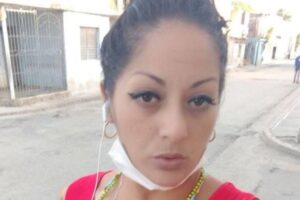
Ana Ibis Tristá Padilla. Photo taken from her social networks.
The set of cases documented in this indicator shares a defining feature: in none of them did the deprivation of liberty respond to the commission of a crime recognizable under international standards, but to the exercise of rights guaranteed by the Universal Declaration of Human Rights and the International Covenant on Civil and Political Rights. They are, by all accounts, acts of criminalization of dissent dressed in legal appearance.
Imprisonment causes irreversible damage in the time it lasts and in the sequelae it leaves. Each day of deprivation of liberty for exercising freedom of expression is an irretrievable day for the victim and her family. The absence of independent judicial mechanisms in Cuba means that none of the documented cases have had access to effective remedies, consolidating impunity as the norm and imprisonment as a permanent warning, as an exemplary act.
3.2.7 Comparison of the behavior of indicators 2024 vs 2025
The comparative analysis 2024-2025 by indicator reveals not only a global quantitative growth of 54.7%, but also a qualitative reconfiguration of the Cuban regime's repressive repertoire.
Source: ICLEP. Final data, years 2024 and 2025.
According to the data recorded, four indicators grew, two decreased, and the relative weight of each one within the total registered significant displacements that allow us to identify an evolution in the strategy of political control of the State:
The shift towards the repression of direct contact. The most defining feature of 2025 is the disproportionate growth in arbitrary detentions, which went from 150 to 386 cases, an increase of 157.3%. This is the largest percentage jump among the indicators that grew and makes arrests the method with the most pronounced displacement within the total composition: their relative weight increased from 19.5% in 2024 to 32.5% in 2025, gaining thirteen percentage points. In practice, this means that in 2025 almost one in three documented violations was arbitrary detention, when in 2024 it was only one in five. Detention ceased to be a complementary instrument to become the hegemonic method of visible repression.
The consolidation of psychological harassment as a structural axis. Attacks, threats and/or psychological aggressions maintained their position as the indicator with the highest absolute volume, growing from 267 to 435 cases (+62.9%) and practically preserving the same, relative weight within the total: they went from 34.8% to 36.6%, with a variation of just 1.8 percentage points. This proportional stability, combined with the growth in absolute numbers, indicates that psychological harassment was not displaced or replaced by other forms of repression, but grew at the same rate as the whole. Its permanence as the most voluminous indicator confirms that the regime conceives it as the permanent support of the control system, effective precisely because it operates continuously, without the visibility costs associated with mass arrests.
The progressive legalization of repression. The abusive use of state power grew from 160 to 276 cases (+72.5%), the second largest percentage increase among the indicators that increased, and its relative weight went from 20.8% to 23.2%. Together with arbitrary detentions, this indicator concentrates in 2025 more than half of all documented violations (55.7%), a proportion that in 2024 was 40.3%. This joint reading is relevant because both indicators share a common feature: the instrumentalization of state institutions—the police, the judiciary, the prosecutor's office, the prison system—as tools of direct or mediated repression. The parallel growth of both suggests a dual strategy: detention as a mechanism of immediate neutralization, and abuse of power as a mechanism of prolonged and exemplary sanction.
The collapse of digital restrictions: sophistication, not retrogression. The decrease from 141 to 41 cases in the indicator of restrictions in the digital space (-70.9%) is the data that, at first glance, could be interpreted as a détente. Contextual analysis rules out that reading. What the data reflect is a change of strategy in the control of the digital environment: the regime abandoned massive and indiscriminate internet shutdowns, which generated international visibility and systematic documentation by specialized organizations, and replaced them with focused and selective interventions – DDoS attacks against specific media, personalized monitoring of accounts, specific territorial cuts – that are more difficult to verify and record. The weight of this indicator fell from 18.4% to 3.5% of the total, which places it in 2025 as the indicator with the lowest proportional representation, when in 2024 it was the third in volume. The divergence between quantitative reduction and qualitative sophistication is a methodological red flag: underreporting in this category may be higher in 2025 than in previous years.
Direct violence, small, but on the rise. Physical aggressions grew from 21 to 32 cases (+52.4%), but maintained exactly the same relative weight within the total in both years (2.7%). This data deserves a double reading. On the one hand, the regime did not resort to physical violence as its primary method, which is consistent with the historical preference for less visible forms of repression. On the other hand, the growth in absolute terms, and the fact that the indicator grew proportionally more than the global average (+54.7% overall compared to +52.4% for this indicator), indicates that direct violence did not reduce or moderate: it grew at the pace of the system. The maintenance of their relative weight indicates that physical violence is not being replaced by other forms of repression, but coexists with them as a resource available and used in a sustained manner.
The Decline in Imprisonment: A Warning About Underreporting. The drop in the incarceration indicator, from 29 to 18 cases (-37.9%), with a reduction in the relative weight from 3.8% to 1.5%, is the data that requires greater interpretative caution. A first reading might suggest that the regime made less use of custodial sentences. However, the documentation of the 2025 monthly reports recorded a considerable number of convictions handed down for events that occurred in 2024 and prosecuted in 2025. The methodological criterion of the ICLEP – which records detentions in the period in which they materialise – can lead to an underestimation when judicial proceedings are prolonged for months before concluding in a sentence. In addition, the shift from repression to the abusive use of state power, which includes prolonged pretrial detention and sentences reported in subsequent periods, suggests that part of the phenomenon that in 2024 was recorded as direct imprisonment migrated in 2025 to this other indicator. Numerical reduction, therefore, does not imply less criminalization of dissent, but possibly a change in the time and mechanism of its formalization.
2025 was not simply a year with more repression, but with a qualitatively different repression: more dependent on arbitrary detention, more anchored to the use of the institutional power of the State, and with apparently less digital control, but in reality more selective and difficult to document. The composition of the indicators confirms the hypothesis of a strategic reconfiguration aimed at maintaining totalitarian control with less international exposure, prioritizing methods that can be presented as acts of law enforcement over those that generate greater external scrutiny.
3.3 Motives and triggers of the aggressions.
What causes unleashed the Cuban regime's repression against freedom of expression and of the press in 2025? How much did they vary from year to year?
Table 5 — Motives and Triggers of Aggressions · 2024–2025 Comparative
| Motive / Trigger | 2024 | 2025 | Variation |
|---|---|---|---|
| Systematic repression | 123 | 197 | +60.2% |
| Participation in religious acts | 2 | 181 | +8,950% |
| Participation in protests | 74 | 162 | +118.9% |
| Publication on social media | 89 | 95 | +6.7% |
| Complaint of prison conditions | 24 | 50 | +108.3% |
| Contact with the international community | 4 | 50 | +1,150% |
| Repression for symbolic expression | 39 | 47 | +20.5% |
| Symbolic date for civil society | 133 | 124 | −6.8% |
| Symbolic date for the regime | 46 | 37 | −19.6% |
| Expression in public spaces | 26 | 21 | −19.2% |
| Retaliation for family ties | 22 | 22 | 0% |
| Journalistic coverage | 9 | 12 | +33.3% |
| Exercise of the right to assembly | 15 | 12 | −20.0% |
| Freedom of artistic and cultural creation | 14 | 9 | −35.7% |
| Citizen documentation of reality | 16 | 9 | −43.8% |
| Refusal to collaborate with State Security | 1 | 4 | +300% |
| Exercise of the right of citizen petition | 3 | 1 | −66.7% |
Source: ICLEP. Note: A single record may have more than one identified motive. The three largest triggers in 2025 — systematic repression (197), participation in religious acts (181), and participation in protests (162) — account for 55.8% of all records.
Source: ICLEP. A single record may have more than one trigger identified.
In 2025, the events or situations that generated the most violations were systematic repression (197 records, 20.4% of the total), participation in religious acts (181 records, 18.7%) and participation in protests (162 records, 16.7%). Together, these three triggers account for 55.8% of all records for the year, which means that more than half of the documented cases responded to one of these three behaviors: the routine and continuous exercise of dissidence, the attempt to attend an act of faith, or the collective expression of social discontent.
The preponderance of systematic repression, understood as the sustained harassment of people for the simple fact of being who they are and thinking what they think, reveals that the regime does not wait for its objectives to do something to act, but rather pursues them preventively and continuously as a policy of structural neutralization.
Participation in religious events as the second trigger in volume is the most striking and distinctive data of 2025. It directly expresses the repressive pattern against the Ladies in White, an organization that was systematically harassed every Sunday of the year when it tried to attend mass to pray for the freedom of political prisoners. The figure sums up an entire year of police operations in front of activists' homes, police summonses, arrests and threats, with the sole aim of preventing the simultaneous exercise of religious freedom and freedom of expression.
The third place of participation in protests reflects the repressive response to the cycle of citizen mobilization generated by the energy and supply crisis during 2025. Prolonged power cuts, shortages of drinking water and food led to spontaneous protests in multiple provinces, to which the regime responded with arrests, physical attacks, interrogations and judicial convictions. The regime not only suppressed the protests as they occurred, but persecuted their participants for weeks and months afterwards through criminal prosecutions.
Contact with the international community and the reporting of prison conditions, with 50 records each in 2025, were two other triggers that registered significant growth compared to the previous year. The first reveals that meeting with a foreign diplomat, giving an interview to an international media outlet or participating in an activity of civil society organizations abroad was enough to become a repressive target. The second shows that political prisoners who made their conditions of detention public, or whose relatives denounced them, were punished with additional disciplinary measures, restrictions on visits, and transfers to punishment cells in direct retaliation.
Repression for symbolic expression, with 47 records in 2025 vs. 39 records in 2024, and which encompasses acts such as carrying posters in public spaces, wearing T-shirts with political messages, placing flowers or candles in places of memory, or writing phrases on walls, is the trigger that best illustrates the regime's total intolerance of any form of visible dissent. no matter how small its scale.
Posts on social networks (with 95 registrations in 2025, six more than in 2024) maintained their relevance as a trigger. Last year, reprisals for Internet publications were channeled through interrogations, detentions, and judicial processes.
An emblematic case of limitation of freedom of expression and of the press on the network had as victims the Spanish youtubers: Raúl, Fabián and Pablo, creators of Black Mango Podcast. After sharing on their Instagram profile a story showing the deterioration of a neighborhood near the Capitol in Havana, they received a call in which they let them know that government officials wanted to meet with them. During the interrogation, they complained about the publication, alluding that "it was causing a bad image" of the country; They checked their phones and asked for their passports, which made them think that they could deny him leave the country. Uncertainty and fear accompanied them until they got on the plane.
"If they do this to us, being foreigners, for a story, what will they not do to the ordinary Cuban? How many are disappeared without anyone knowing?" the boys reflected in an episode of their Black Mango podcast, openly describing Cuba as an intolerant dictatorship. 36
The truth is that in Cuba, social networks, instead of being a space free of debate, have become a monitored terrain where State Security seeks to sow fear and self-control.
The young man from Santiago Yasmani Echavarría was harassed by State Security agents after publicly commenting on a social media post the phrase: "Let's go to the street." According to reports, the agents showed up in his neighborhood and even contacted the president of the local CDR to inquire about his whereabouts, generating alarm among the neighbors 37. Likewise, citizen Enrique Ramos Bosch was arrested on December 9 and transferred to the Versailles Operations Center, allegedly for posting a complaint on Facebook about the prolonged blackouts and for directing criticism of the regime of Miguel Díaz-Canel. The authorities accuse him of "contempt", but it is nothing more than a new case of repression for expressing an opinion on social networks 38.
Retaliation for family ties – the so-called vicarious repression – remained stable at 22 records, the same figure as in 2024. This trigger documents one of the most perverse forms of repression: punishing the relatives of political prisoners, journalists or activists as a mechanism of indirect pressure on the main victim. The systematic persecution of mothers, wives and children of 11J prisoners is its most documented expression throughout the year.
The triggers that decreased in number from 2024 to 2025 also reveal significant trends. The symbolic date for civil society fell from 133 to 124 registrations (-6.8%), and the symbolic date for the regime from 46 to 37 (-19.6%). The joint decline of both suggests that repression in 2025 was more evenly distributed throughout the year, without concentrating as markedly on specific dates as in 2024, which is consistent with the analysis of the monthly distribution: the repression of 2025 had higher floors in all months, not only in those with greater symbolic value.
The exercise of freedom of artistic and cultural creation fell from 14 to 9 records (-35.7%), and citizen documentation of reality from 16 to 9 (-43.8%). Both declines do not imply greater tolerance towards critical art or citizen journalism, but rather the consolidation of the accumulated deterrent effect: the imprisonment of artists such as Fernando Almenares Rivera or Leonard Richard González Alfonso produces self-censorship in other creators who decide not to document or express so as not to become the next target.
The joint reading of both years confirms a central trend: with each passing year, the space of what is allowed shrinks, and the space of what is punished expands.
3.4 Profile of the victims
During 2025, ICLEP identified a total of 968 records distributed among the different categories of victims, a figure that is lower than the total number of documented violations (1188) because the same event may involve more than one victim, but higher than the number of people affected because the same victim may accumulate more than one record throughout the year. This last clarification is not a minor methodological detail: it is, in itself, one of the most revealing conclusions of the report. That the number of searches exceeds the number of individual victims identified means that the Cuban regime does not repress once and stop. The repressive recidivism of the same people is a structural feature of the Cuban system of political control, not an anomaly.
This phenomenon – which ICLEP calls cumulative repression – has a precise function within the regime's control strategy: it does not only seek to punish a specific act of dissidence, but to wear down the victim morally, economically and psychologically until he abandons activism, journalism or public denunciation. Each new aggression against a victim already registered is a signal directed simultaneously at him and at those around him: the State has memory, has unlimited resources to repress and has the will to persist. The victim, on the other hand, has only one life, a single family and a finite threshold of resistance.
Table 6 — Classification of Victims by Category · Year 2025
| Victim Category | Records | Distribution | % of Total |
|---|---|---|---|
| Activist | 292 | 30.2% | |
| Citizen (no affiliation) | 181 | 18.7% | |
| Journalist | 163 | 16.8% | |
| Political Prisoner | 161 | 16.6% | |
| Opponent | 105 | 10.8% | |
| Former Political Prisoner | 17 | 1.8% | |
| Artist / Creator | 14 | 1.4% | |
| Social Media Profile | 14 | 1.4% | |
| Press Outlet | 7 | 0.7% | |
| Content Creator | 6 | 0.6% | |
| Religious | 4 | 0.4% | |
| Common Prisoner | 2 | 0.2% | |
| Organization | 2 | 0.2% | |
| TOTAL | 968 | 100.0% |
Source: ICLEP. Total records (968) are lower than total violations (1,188) because one record may include more than one repressive indicator; and higher than total individuals identified because the same person can accumulate multiple records throughout the year.
Source: ICLEP. Final data, year 2025.
The category with the highest volume of registrations in 2025 was that of activists, with 292 cases representing 30.2% of the total. Activism in Cuba is not a political activity in the conventional sense of the term, since the one-party system prohibits any form of independent political organization. What ICLEP classifies as an activist is, in most cases, a person who demands compliance with internationally recognized rights: the right to demonstrate, to assemble, to express oneself, to defend others. That this category tops the table with almost a third of all registrations for the year reflects the regime's determination to neutralize any form of independent civic organization, no matter how modest its scale of action.
Citizens without recognized political affiliation are in second place with 181 registrations (18.7%). This is one of the most significant in the report because it documents the expansion of repression beyond organized dissident circles. A citizen in the ICLEP classification is a person who is not a journalist, is not a known activist, does not belong to any opposition organization: it is someone who posted a comment on Facebook, who protested against a blackout in his neighborhood, who filmed a queue with his phone, who shouted a slogan from the window of his house. The fact that 181 records correspond to this category confirms that the Cuban regime does not tolerate dissent even in its most spontaneous, disorganized, and apolitical form. The repression in 2025 reached ordinary citizens with an intensity that is unprecedented in the records of ICLEP.
Journalists accumulated 163 registrations (16.8%), a figure that should be read with a methodological caveat already pointed out in other sections of this report: the number of active journalists in Cuba is decreasing, because most have had to go into exile due to the impossibility of exercising in minimum security conditions. The fact that 163 records fall into this category does not reflect the full extent of the pressure on the independent press, but only the one that was possible to document on those who still remain on the island. The repressive density per active journalist is, consequently, considerably higher than the absolute number suggests.
Political prisoners accumulated 161 records (16.6%), which confirms that the prison system is in itself a space of continuous repression and not only the final destination of a sentence. Being a political prisoner in Cuba does not imply being outside the reach of the repressive apparatus: it implies remaining within it permanently and without the possibility of direct denunciation. The records corresponding to this category include physical assaults inside prisons, transfers to punishment cells, suspension of visits and telephone calls, denial of medical attention, prohibition of access to reading materials and reprisals for statements or complaints leaked abroad. Each of these acts is an additional violation to that already represented by the deprivation of liberty itself, and each one generates an independent record in the ICLEP system.
Opponents registered 105 cases (10.8%). Unlike activists, whose action is usually civic and vindictive, opponents are people who hold political positions explicitly opposed to the regime and who act, as far as possible, as organized alternatives to the established power. Its volume of records confirms that the regime maintains a specific and sustained surveillance of this sector.
The category of former political prisoners, registered with 17 cases, documents a phenomenon that the 2024 report did not capture with this intensity: people released from prison – whether by serving their sentence, on parole or in the framework of diplomatic negotiations – do not regain the full exercise of their rights when they leave prison. They continue to be surveilled, harassed, summoned and even re-imprisoned. The cases of Donaida Pérez Paseiro and Jaime Alcides Firdó Rodríguez, already documented under the heading of imprisonment, illustrate that the condition of former political prisoner in Cuba is often a state of supervised and precarious freedom that can be reversed at any time at the will of the State.
The categories of artists and creators (14 records), social media profiles (14 records), and content creators (6 records) document the extension of repression to new actors who, in the perception of the regime, represent emerging forms of cultural and informational dissidence. Social media profiles as a victim category reflect events in which the aggression is directed against a digital account or profile, rather than against an identified natural person. Its inclusion as a separate category responds to ICLEP's methodological desire to document repression in the digital environment with the same precision as in physical space.
The media as institutional victims (7 registers) and organizations (2 registers) complete the picture with a collective dimension: repression not only affects individuals, but also the structures that group them together and give them projection.
The data in the table, read in its entirety, describe a society subjected to a system of surveillance and punishment. In Cuba, repression has neither a single target nor a defined limit: it follows an expansive logic aimed at turning silence into the rule.
3.5 Gender-neutral repression: analysis of victims by sex
The distribution of ICLEP records by gender of the victim offers an additional perspective on the structural scope of repression in Cuba: the state apparatus does not discriminate based on the sex of the person who expresses himself. It represses those who speak, regardless of who they are.
Table 7 — Violations by Gender of Victim · Year 2025
| Category | Records | Visual | % of Total |
|---|---|---|---|
| Male | 532 | 55.0% | |
| Female | 394 | 40.7% | |
| Social media profile | 14 | 1.4% | |
| Media (institutional) | 8 | 0.8% | |
| Organization | 3 | 0.3% | |
| N/A (unidentified / group) | 17 | 1.8% | |
| TOTAL | 968 | 100.0% |
Source: ICLEP. Final data 2025. · The regime does not discriminate by gender: women represent over 4 in every 10 documented records. The difference between male and female proportions reflects the sociological composition of Cuban dissidence — not a lower level of repression against women. Specific forms of gendered violence (e.g., sexual assault) are documented within the physical aggressions indicator.
Men accumulate 55.8% of the registrations and women 41.3%. The difference is 14.5 percentage points. This, however, should not be interpreted as less pressure on the female population. It is, in any case, the reflection of a sociological composition of Cuban dissidence, in which men are more numerous in absolute terms in categories such as political prisoners and opponents.
The truth is that the regime does not establish a gender distinction in the application of coercion. The presence of women in more than four out of ten records of violations is a reflection, first, of their participation in activism, independent journalism and the defense of Cuba's freedom, and second, of the willingness of the repressive apparatus to respond to that presence with the same methods and the same intensity that it uses against men.
Repression in Cuba is vertical in nature: it falls on those who express themselves without regard to the gender, age, social status or political affiliation of the victim. What activates the response of the repressive apparatus is not who speaks, but the fact of speaking. This verticality is one of the most totalitarian features of the system: the absence of selection criteria based on the profile of the victim means that no one who dissents is safe, and that the deterrent effect of each aggression is projected on the population as a whole without distinction.
The verticality of repression does not imply, however, that the repressive experience is identical for men and women. The threshold for repression is equally low for both, but the specific forms that repression takes may differ according to the gender of the victim, incorporating in some cases dimensions of violence aimed at violating the dignity of women in a particular way: sexual assault as a tool of interrogation and pressure on the maternal role as a vector of emotional destabilization are modalities documented in the 2025 records that aggravate the violation of rights, already serious, against women.
The gender-disaggregated analysis is an element that ICLEP will take into account for future reports, with the aim of documenting these specificities more precisely.
3.6 Main perpetrators
The analysis of the entities responsible for the violations of freedom of expression and of the press documented by ICLEP in 2025 confirms a reality that does not admit nuances: repression in Cuba is, in its entirety, a state policy. Of the 968 records that make up the ICLEP database for 2025, in 953 the identified perpetrator belongs to the Cuban state apparatus. It is not a question of individual excesses, of sporadic abuses by officials out of control or of isolated episodes that the State could invoke as alien to its institutional will. It is a coordinated, sustained and deliberate machine, which uses its own structures to silence those who exercise their right to express themselves freely.
State Security tops the list of violating entities with 423 records, 43.7% of the total identified. Its predominance is not surprising: the Cuban political police operate as the organizing brain of repression, designing and coordinating operations, managing the permanent surveillance of activists and journalists, executing summonses and interrogations, and directing actions of sustained psychological harassment. Unlike other repressive bodies, State Security often acts covertly, which means that its real presence in the documented events is probably greater than the figure reflects.
The National Revolutionary Police (PNR) accumulates 356 records, 36.8% of the total. It is the most visible executing arm of daily repression: it carries out arbitrary arrests, intervenes in the dissolution of demonstrations, transfers victims to police units, guards surveillance operations and executes the orders that State Security designs. Frequently, the actions of the PNR and State Security are simultaneous, which explains why many registries have both as perpetrators.
The Penitentiary System appears with 118 records (12.2%), a figure that confirms that the deprivation of liberty is not the end of the repressive process but one more phase of it. The records associated with this entity correspond to physical assaults inside prisons, arbitrary disciplinary sanctions, suspension of visits and communications, denial of medical attention, transfers to punishment cells and conditions of detention that constitute in themselves cruel, inhuman and degrading treatment. The Cuban prison system functions as an extension of the repressive apparatus within its own facilities, applying additional punishments to people who are already deprived of liberty for exercising fundamental rights.
The Judicial System registers 113 cases (11.7%) as a perpetrator, which confirms the lack of judicial independence in Cuba. The Cuban courts do not act as guarantors of rights vis-à-vis the executive branch, but as its instrument of legitimation. Disproportionate sentences for "propaganda against the constitutional order," arbitrary revocations of parole, trials without minimum procedural safeguards, and the use of ambiguous criminal offenses to criminalize dissent are the ways in which the judicial system appears as a perpetrator in ICLEP records. His presence not as an arbitrator but as an aggressor is one of the most serious indicators of the rule of law in Cuba.
The state media accumulate 54 registrations (5.6%), which makes them the fifth perpetrator in volume. Their repressive function is not physical but symbolic and institutional: they defame, discredit, fabricate narratives of criminalization against independent journalists, activists and opponents, and lend the state's propaganda apparatus to coordinated harassment campaigns.
ETECSA, the state telecommunications monopoly, accumulates 34 registrations (3.5%) as a perpetrator. Their presence is methodologically relevant because it makes visible a form of repression that does not require uniformed agents or arrest warrants: the control of connectivity infrastructure as an instrument of censorship. Selective internet cuts, individualized blocking of service to critical users and the arbitrary increase in tariffs as an economic barrier to access to information are the ways in which ETECSA appears in the records. The state monopoly on telecommunications turns this company into a tool of structural repression whose action does not require visible violence to be effective.
Civilians acting on behalf of the State total 21 registrations (2.2%). This category documents one of the most perverse mechanisms of the Cuban repressive system: the delegation of harassment to people with no formal institutional ties, who act as proxies for the State in acts of repudiation, neighborhood pressure campaigns, fabricated complaints to state agencies and informal surveillance of dissidents. Their presence as perpetrators in the ICLEP records confirms that the regime not only employs its officials to repress, but also recruits sectors of the civilian population as an extension of the control apparatus.
The Ministry of Higher Education closes the list with 13 records (1.3%), mainly corresponding to reprisals against university students who protested the increase in ETECSA fees in June. Universities carried out interrogations, threats of expulsion, search of mobile devices and pressure to delete communications. Its role as an institutional perpetrator confirms that repression penetrates academic spaces with force.
Year after year, ICLEP confirms that in Cuba the State is not the guarantor of fundamental rights, but their main violator. Every institution that should be protecting citizens — the police, the courts, the prison system, the media, the telecommunications company, the universities — appears in our records as aggressors. This total reversal of the institutional function of the state is the most accurate expression of what it means to live under a totalitarian system, where the exercise of freedom of expression is a true fallacy.
actors
Source: ICLEP. Final data, year 2025.
3.7 Territorial distribution of violations
Table 8 — Distribution of Records by Territory · Year 2025
| Territory | Records | Distribution | % of Total |
|---|---|---|---|
| Provinces and Special Municipality | |||
| Havana | 368 | 38.0% | |
| Matanzas | 134 | 13.8% | |
| Villa Clara | 116 | 12.0% | |
| Santiago de Cuba | 60 | 6.2% | |
| Granma | 47 | 4.9% | |
| Holguín | 32 | 3.3% | |
| Camagüey | 31 | 3.2% | |
| Mayabeque | 29 | 3.0% | |
| Guantánamo | 27 | 2.8% | |
| Pinar del Río | 25 | 2.6% | |
| Artemisa | 23 | 2.4% | |
| Las Tunas | 19 | 2.0% | |
| Sancti Spíritus | 18 | 1.9% | |
| Cienfuegos | 13 | 1.3% | |
| Isla de la Juventud | 4 | 0.4% | |
| Ciego de Ávila | — | — | |
| Non-Territorial Categories | |||
| Digital Environment | 15 | 1.5% | |
| Foreign (outside Cuba) | 7 | 0.7% | |
| TOTAL | 968 | 100.0% | |
Source: ICLEP. · Havana, Matanzas, and Villa Clara account for 63.8% of all records. · Zero records in Ciego de Ávila and low figures in other provinces do not indicate lower repression intensity — they reflect reduced documentation capacity. ICLEP defines this as "structural underreporting": the data presented are the floor, not the ceiling, of what is actually happening across Cuba.
Source: ICLEP. Final data, year 2025.
The territorial distribution of ICLEP records in 2025 allows for a reading that goes beyond the simple geography of repression. The numbers do not only describe where the violations occurred: they also describe, and just as eloquently, where fear has been effective enough to prevent the violations from ever being documented.
Havana concentrates 38% of all registrations for the year, followed by Matanzas with 13.8% and Villa Clara with 12.0%. The three territories account for 63.8% of the national total. A hasty reading could conclude that repression is fundamentally a phenomenon in the capital and in the central zone. That would be a wrong conclusion. What these numbers reflect, in the first place, is that Havana is the headquarters of the largest concentration of civil society organizations, independent media, activists with public projection and documentation networks of ICLEP. The greater the registration capacity, the greater the number of verified cases.
In Matanzas, the volume of registrations responds directly to the intensification of repression against the Ladies in White throughout the year, and the province concentrates a substantial part of its most active members. The same case shot up the numbers in Villa Clara, where judicial proceedings stemming from the protests against the 2024 blackouts in Manicaragua also produced a considerable volume of records associated with the abusive use of state power.
The other end of the table is where the most disturbing analysis lies. Ciego de Ávila registers zero cases, Cienfuegos: 13, Sancti Spíritus: 18, and Isla de la Juventud: 4. The temptation to interpret these numbers as a sign of a lower intensity of repression in these territories must be firmly resisted. Cuba is a unitary state with an apparatus of centralized political control and homogeneously deployed throughout the national territory. State Security, the National Revolutionary Police, the prison system and all institutions operate with the same logic and the same repressive will in all territories. What changes is not repression: it is the possibility of documenting it.
In provinces with less presence of independent documentation networks, with a lower density of activists with connections to the outside, with less access to secure communication tools and with greater isolation from the information circuits of the diaspora, violations occur, but are not recorded. Victims do not report because they do not know who to do so, because they do not trust that the complaint will produce any result, because they fear that the act of reporting will generate additional retaliation, or simply because they do not have the technical means to do so safely. In these territories, silence is not the absence of repression: it is its most finished product.
This phenomenon has a precise name in the literature on press freedom and human rights: structural underreporting. It is not a failure of the ICLEP documentation system, but a direct consequence of the Cuban repressive model, which operates most effectively precisely where the capacity to report is weakest.
The "Digital Environment" category, with 15 records, introduces a dimension that transcends physical geography: there are violations that occur in a space without coordinates, where the victim can be anywhere in the national territory or even outside it. Its inclusion as a separate category reflects ICLEP's methodological decision not to force artificial geolocation. The 7 records under the category "Foreigner" document something equally relevant: the geography of Cuban repression is broader than the map of the island. As evidence, there are the threats beyond borders against journalists José Luis Tan Estrada, Orlidia Barceló, José Jasán Nieves and Armando Campuzano.
The correct reading of this table is not, therefore, that of a map of repression but that of a map of the visibility of repression. And that distinction is, in itself, one of the most important conclusions that ICLEP can offer to international organizations, democratic governments and human rights organizations that use this report as a source: the figures presented here are the floor, not the ceiling, of what is really happening in Cuba. The real magnitude of violations of freedom of expression and of the press in the country is greater than any external documentation system can verify.
3.8 Related rights violated
The violations of freedom of expression and of the press documented by ICLEP in 2025 took place in a context of simultaneous and systematic infringement of related rights recognized by international instruments such as the International Covenant on Civil and Political Rights (ICCPR), the Universal Declaration of Human Rights (UDHR) and the United Nations Principles for the Protection of Human Rights Defenders.
Right to a fair trial and due process
The Cuban judicial system acted during 2025 as an instrument of criminalization of dissent and the exercise of journalism. The 276 documented cases of abuse of state power show a pattern of criminal proceedings characterized by the absence of minimum procedural guarantees: arrests without a warrant, undue prolongation of pretrial detention, absence of judicial independence, weak evidence, tampering with witnesses, and the imposition of disproportionate sanctions.
The convictions handed down in October against six protesters in Manicaragua for calling for the restoration of electricity service, the sentences of up to 14 years against people tried for their social media posts, and the prosecutions of evangelical pastors for expressing religious beliefs during a trial illustrate the instrumentalization of the legal framework as a tool of political repression.
Of special relevance is the situation of the processes derived from the 2024 protests that were processed in 2025: in September, the trial against 15 citizens for the demonstrations of March 17, 2024 in Bayamo began, with prosecutorial requests of between two and seven years in prison; and in that same month, the trial against journalist José Gabriel Barrenechea Chávez and four demonstrators in Encrucijada, Villa Clara, for the protests against the blackouts was concluded for sentencing.
Right to political participation and participation in public life
In Cuba, the creation of independent political parties is prohibited and the one-party system prevents any form of plural political participation. During 2025, the repression of political participation manifested itself mainly through the criminalization of any expression of dissent, the surveillance of activists and opponents, and the imposition of mobility restrictions that impede civic organization.
The case of the Ladies in White is paradigmatic: a women's organization whose only visible political expression is attending mass and praying for the freedom of political prisoners was the subject of 182 records of repression documented by ICLEP throughout the year. The investigation opened against Berta Soler and Ángel Moya for alleged conspiracy against the constitutional order, after meeting with a US diplomat, illustrates the criminalization of contact with the international community as a political act.
In October, the ICAIC terminated the contracts of filmmakers Kiki Álvarez and Esteban Insausti in retaliation for their critical stances towards the state's cultural policies, evidencing that participation in public life through artistic creation is also subject to political control.
The effective elimination of the right to political participation not only affects people's freedom of expression, but also deprives Cuban society of the basic mechanisms of accountability and democratic representation.
Right to peaceful assembly and demonstration
The 162 attacks for participation in protests (+118.9% compared to 2024) and the 181 attacks for participation in religious events documented in 2025 confirm that the right to peaceful assembly and demonstration continues to be systematically annulled. The regime deployed preventive repressive operations on dates of high symbolic value, physically blocked access to churches, and imposed arrests as a mechanism of collective deterrence.
The most illustrative cases were the police sieges around 11J in July, the operations against the Ladies in White in their attempts to attend Sunday mass, and the repressive responses to spontaneous protests motivated by water shortages and blackouts: in Havana, on September 29, three women who blocked the passage of vehicles with empty buckets to demand drinking water were intimidated by PNR agents and State Security; in Gibara, at least four people were arrested for protesting against the blackouts.
These actions confirm that the Cuban regime applies a policy of zero tolerance to any form of collective expression of discontent, without distinction between protests of a political nature and demands for basic needs.
Right to protection of journalists and human rights defenders
The exercise of independent journalism and the defense of human rights continued to be high-risk activities in Cuba during 2025. The 163 records of attacks against journalists include 69 arbitrary detentions, 121 attacks and threats, and 19 restrictions on the digital space, in addition to the three documented cases of physical aggression and the case of abusive use of state power.
Not only does the regime fail to comply with its obligation to protect journalists and defenders, but it acts as the main perpetrator of the attacks. State Security coordinated smear campaigns, intimidating summonses, and systematic harassment against journalists and media directors. Several journalists had to go into exile during 2025 or were subject to restrictions on leaving the country.
CPJ included Yunia Figueredo's case in its international alerts, calling on the regime to cease harassment against her and her husband. The campaign against El Toque – which combined digital attacks, acts of repudiation abroad and defamatory television reports – shows the sophistication and transnational reach that repression against independent media can acquire.
The absence of institutional protection mechanisms and the impunity guaranteed to aggressors generate a climate of structural fear that restricts the exercise of journalism and encourages self-censorship as a survival mechanism.
Right to freedom of movement
The mobility restrictions documented during 2025 – house fences, permanent surveillance, preventive detentions and bans on leaving the country – constituted a control mechanism that complemented the direct repression. Its function was to prevent coverage of events, access to sources, participation in civic activities and contact with the international community.
In addition to the cases of journalists banned from leaving the country, ICLEP documented movement restrictions imposed on activists during visits by foreign diplomats, mobility blockades on commemorative dates, and perimeter police operations around the homes of visible opponents.
Right to effective remedy in case of violations
The structural impunity of the Cuban system constitutes one of the most serious features of the pattern of violations documented. None of the attacks recorded by ICLEP in 2025 had judicial or administrative channels of response that have produced consequences for the perpetrators. The complaints filed by the victims, when they dared to make them, were ignored, filed or responded to with new reprisals.
The systematic denial of reparation reinforces the message of lack of protection that the regime uses as a social deterrent, perpetuates the trauma of the victims and consolidates impunity as an institutional norm. In the absence of an independent judiciary, access to justice for victims of violations of freedom of expression and of the press in Cuba is structurally impossible.
3.9 Main repressive patterns identified in 2025
The patterns described below are not findings unique to 2025. They are, for the most part, constants documented by ICLEP since the first years of its systematic monitoring, which are intensified, modulated or acquire new forms depending on the context, but which never disappear. Their identification year after year is not a reiteration: it is evidence that the Cuban regime does not reform its repressive practices. He perfects them.
- Preventive and planned repression. The regime not only responds to acts of dissidence, but anticipates them. The operations around symbolic dates (11J, May 1, anniversary of the Maleconazo, International Human Rights Day) and the anticipation of diplomatic visits show an institutional coordination of repression aimed at neutralizing critical voices before they act.
- Legalization of repression. The instrumentalization of the judicial system to criminalize dissent, impose disproportionate sentences and legitimize arbitrary detentions under the guise of legality is one of the most worrying features of the year. The regime shifted part of the repression from the police to the judicial and administrative spheres to reduce its international visibility.
- Expansion of the repressive target. In 2025, the trend observed in 2024 was consolidated: repression is no longer directed exclusively at journalists and recognized opponents, but reaches ordinary citizens who express their disagreement on social networks, artists, religious people, students and relatives of political prisoners. This phenomenon of "vicarious repression" amplifies the intimidating effect of the State.
- Tactical modulation of repressive intensity. The cycle of high repression (March-July), tactical decline (August) and rebound (September-December) confirms that the regime adjusts the visibility of repression according to international scrutiny, but maintains a structurally high floor of coercion that prevents the full exercise of freedoms.
- Sophisticated and selective digital control. Although the number of digital restrictions registered decreased significantly (-70.9%), this does not reflect a lower censorship capacity, but a greater targeting: the regime abandoned massive and indiscriminate internet blockades in favor of selective cuts, targeted cyberattacks, and personalized surveillance of social media profiles.
- Transnational repression. The act of repudiation against the director of El Toque in Mexico City and the restrictions imposed on Cuban exiles who visited the island confirm that the regime's repression does not stop at national borders.
4. Forecasting
Repression Without Ceiling:
Projections for 2026
Based on two years of systematic documentation, ICLEP identifies the structural trends most likely to define the repressive landscape in Cuba over the coming year.
The data documented by ICLEP during 2025 does not only describe what happened in the past year. Read in continuity with the 2024 figures, and analyzed against the structural conditions that generate repression in Cuba, they make it possible to formulate evidence-based projections about the direction that violations of freedom of expression and of the press are likely to take in 2026. These are not speculative estimates: they are trend lines derived from two years of systematic monitoring, cross-referenced with the political, economic, and social context in which the Cuban regime operates.
The forecasts presented in this section are organized around five dimensions: the overall volume of violations, the evolution of the most dynamic indicators, the expansion of the repressive target, the consolidation of the legal and administrative repression, and the likely intensification of transnational repression. Each projection is accompanied by the empirical basis that sustains it and a confidence assessment.
The trajectory from 2023 to 2025 describes a structural upward pattern. In 2023, ICLEP documented violations at a level that 2024 surpassed. In 2024, the 768 violations documented surpassed the previous baseline. In 2025, 1,188 cases were recorded — a 54.7% increase. Each year's peak has become the next year's starting point.
This pattern is not coincidental. It is the expression of a regime that does not retreat: it recalibrates. The tactical modulation identified in the monthly analysis — moderate beginning, sustained escalation, brief pause, rebound — shows that repression does not decrease structurally; it fluctuates in visibility while its floor rises. Based on this documented tendency, ICLEP projects a total volume of between 1,300 and 1,500 violations for 2026, an increase of between 9% and 26% compared to 2025.
The lower bound of this estimate assumes that the regime maintains its 2025 repressive intensity without major escalations. The upper bound responds to the scenario in which one or more triggering events — an anniversary of the 11J protests, a new wave of citizen mobilization around energy or food shortages, or an intensification of diplomatic pressure — produce a repressive escalation comparable to that of June–July 2025.
Arbitrary detention went from 150 cases in 2024 to 386 in 2025, a 157.3% increase that made it the indicator with the greatest structural displacement within the total: from 19.5% to 32.5% of all violations. In 2025, almost one in every three documented violations was an arbitrary detention. ICLEP projects that this indicator will maintain its hegemonic position in 2026, and could approach or exceed 400 cases if the pattern of preventive operations around symbolic dates is repeated.
The logic sustaining this projection is operational: arbitrary detention offers the regime the highest deterrence-to-visibility ratio of all repressive methods. It neutralizes targets immediately, it does not require judicial process, it leaves no permanent marks, and it sends a dissuasive message to the victim's entire environment. In a context where mass arrests in 2021 generated sustained international scrutiny, the regime has refined the use of brief and selective detentions as a method that achieves the same objective of neutralization with substantially lower political cost.
The abusive use of state power grew 72.5% in 2025, recording 276 cases and increasing its relative weight within the total from 20.8% to 23.2%. The trend confirms a deliberate repositioning of repression from the street to the courtroom, from the patrol car to the pretrial detention cell, from the police summons to the formal criminal charge.
This shift has a clear strategic logic: judicial repression is more difficult to document, harder to denounce internationally, and generates less immediate visibility than mass arrests. A person sentenced to 14 years in prison for a social media post represents, from the regime's perspective, the same neutralization as years of arbitrary detention, but with the added value of a legal document that the Cuban State can invoke as evidence of institutional normalcy.
ICLEP projects that abusive use of state power will reach or exceed 300 cases in 2026, and that the ratio of violations per record — currently 1.23 — will increase as judicial processes initiated in 2025 conclude with sentences registered in 2026. The pipeline of pending criminal proceedings from 2025 — protests, social media publications, contacts with the international community — constitutes a documented reservoir of future judicial repression.
One of the most significant transformations documented between 2024 and 2025 was the expansion of the repressive target beyond recognized dissident circles. In 2025, 18.7% of all records corresponded to citizens without identified political affiliation — people who posted a complaint on social media, filmed a queue, protested a blackout, or shouted a slogan. This category grew in both absolute and relative terms compared to 2024.
ICLEP projects that this expansion will continue in 2026 for structural reasons: the economic deterioration that generates spontaneous protests is not reversible in the short term, the social media ecosystem in Cuba continues to grow despite restrictions, and the regime has demonstrated the will and operational capacity to repress expressions of dissent in their most informal and disorganized manifestations. The Cuban citizen who posts a protest on Facebook is as much a target as the journalist who writes an article — and is significantly less protected.
Equally relevant is the projected continuity of repression against religious communities. The 181 records linked to participation in religious acts in 2025 — almost entirely associated with the systematic persecution of the Ladies in White — confirm that the regime perceives the simultaneous exercise of religious freedom and freedom of expression as a threat requiring permanent neutralization. As long as the Ladies in White continue to attempt to attend mass to pray for political prisoners, ICLEP expects this category to generate a substantial volume of records in 2026.
The reduction from 141 to 41 documented cases in the digital restrictions indicator between 2024 and 2025 (-70.9%) should not be interpreted as a relaxation of control over the digital space. The contextual analysis conducted in this report identifies a change of strategy, not a change of intent: the regime moved from mass internet shutdowns — highly visible and systematically documented — to selective, targeted, and difficult-to-verify interventions.
For 2026, ICLEP projects that documented digital restrictions will remain low in absolute terms — probably in the range of 35–55 cases — while the actual intensity of digital control will increase. The strategic investment in selective blocking of specific social media accounts, personalized connectivity cuts, DDoS attacks against specific media, and surveillance of private communications will generate an impact on the digital ecosystem disproportionate to what the documented figures reflect. The gap between recorded violations and actual violations is projected to be wider in this indicator than in any other.
The case of ETECSA, which in 2025 generated 34 records as a perpetrator, illustrates the structural mechanism: a telecommunications monopoly operating as a repressive instrument does not need uniformed agents or arrest warrants to silence critical voices. It is enough to cut service at a politically sensitive moment, to impose economic barriers through tariff hikes, or to selectively block accounts identified as critical. This form of repression leaves no obvious marks and is very difficult to attribute formally.
In 2025, ICLEP documented for the first time a significant cluster of repressive actions against Cuban journalists and activists outside the national territory: the act of repudiation against the director of El Toque in Mexico City, the risk of deportation of journalist Orlidia Barceló from Bolivia, the harassment of exiled journalists, and the restrictions imposed on activists who visited Cuba from abroad. These 7 records under the "Foreign" category represent a qualitative shift in the geography of Cuban repression.
ICLEP projects that transnational repression will grow in visibility and volume in 2026. Three factors sustain this projection: first, the Cuban diaspora continues to expand, and with it the number of journalists, activists and civil society organizations operating from third countries; second, these actors are increasingly effective at international advocacy, creating incentives for the regime to harass them in their countries of residence; and third, the precedents of 2025 demonstrate that the regime is willing and capable of projecting its repressive reach beyond its borders.
Source: ICLEP. 2023–2025 documented data. 2026 projection based on structural trend analysis (low: +9%, high: +26% vs. 2025).
Source: ICLEP. Projections based on structural trend analysis from 2023–2025 documented data.
Source: ICLEP. 2024–2025 documented. 2026 projected ranges based on trend analysis.
5. Conclusions
The 1,188 violations of freedom of expression and of the press documented by ICLEP in 2025 are not a statistical accident or the consequence of an exceptional situation. They are the logical continuation of a state policy that has been operating for decades with the same objective: to maintain a monopoly on public discourse and suppress any voice that challenges it. ICLEP has been documenting this reality since 2016. In that period, no year has closed with less repression than the previous one in a sustained manner. 2025 confirms this trend with a figure that is 54.7% higher than that of 2024 and that consolidates the year as one of the most repressive of the last three years.
Five conclusions emerge from the year's analysis:
Repression is a policy, not a reaction. The three-phase pattern documented in 2025—moderate onset, sustained escalation, tactical modulation—is identical to that of 2024 and consistent with the cycles seen in previous years. Repression in Cuba does not respond to the level of dissident activity: it precedes and anticipates. The regime represses preventively because it has decided that silence is a condition of governability, not a consequence of it.
The Cuban state is the maximum perpetrator. In 953 of the 968 documented records, the perpetrator belongs to the state apparatus. There is no significant parastatal repression in Cuba because it is not necessary: the state has the capacity, will, and resources to exercise it directly through all its institutions. The fact that the judicial system, the prison system, the media, ETECSA and the universities appear as perpetrators along with the police and State Security confirms that repression is not an anomaly of the system: it is the system functioning according to its design.
The target has expanded irreversibly. In 2025, 30.2% of registrations correspond to activists and 18.7% to citizens without recognized political affiliation. The repression is no longer directed primarily against independent journalism – whose reduction reflects the mass exile of its members, not less pressure – but against any expression of dissent, no matter how spontaneous, disorganized or modest. This expansion of the white is one of the most serious transformations documented in the last two years.
The legalization of repression is its most dangerous face. The 72.5% growth in the abusive use of state power and the displacement of part of the repression from the police to the judicial and administrative space indicate that the regime is investing in the construction of a repressive architecture that can present itself as legal to the international community. Fourteen-year sentences for social media posts, trials of protesters who banged cauldrons, revocations of parole for continuing to express themselves: all of this has the appearance of a legal process. None of this is under any international human rights standard.
Self-censorship that is not documented is also a result. The decrease in the records of citizen documentation (-43.8%) and critical artistic creation (-35.7%) does not indicate less creative or journalistic activity in Cuba. It indicates that the cumulative deterrent effect of years of repression has produced its most sought-after result: people who decide not to express themselves so as not to become the next case documented by ICLEP.
6. Recommendations
To international human rights organizations: IACHR, Special Rapporteurship, UN Special Rapporteur, Human Rights Council:
- Intensify monitoring of the situation of freedom of expression and of the press in Cuba, with special attention to patterns of preventive repression, criminalization of dissent, and deterioration of conditions in the prison system.
- Demand that the Cuban State provide detailed information on the situation of all imprisoned political prisoners and journalists, and on the conditions of their detention.
- Include in the Universal Periodic Review mechanisms the findings of this report and other documents of accredited organizations that systematically document repression in Cuba.
To democratic governments and the international community:
- To exert coordinated political and diplomatic pressure on the Cuban State, making the release of political prisoners and the cessation of repression explicit conditions for any process of normalization of relations.
- Support Cuban civil society organizations in exile that document human rights violations and support independent journalism, recognizing their work as an essential public service in the absence of freedom of information on the island.
- Publicly denounce the transnational repression documented in this report, including acts of harassment of Cuban journalists and activists in third countries, and adopt measures to guarantee their protection.
To the specialized organizations: UNESCO, CPJ, RSF, ARTICLE 19, IFEX:
- Include in its international indexes and rankings the verified data of ICLEP as a primary source on the situation of freedom of expression and of the press in Cuba.
- Activate the mechanisms for alerting and protecting journalists in the cases documented in this report, with special attention to those who remain working from the island in conditions of extreme vulnerability.
- Promote ICLEP's participation as an observer organization in international human rights forums where Cuba is evaluated.
7. Bibliography
- The threats against the university population as a result of their protests against the increase in the prices of mobile data service are documented in the ICLEP database with the following codes: OCLE-2025-988; OCLE-2025-990; OCLE-2025-991; OCLE-2025-992; OCLE-2025-993; OCLE-2025-997; OCLE-2025-998; OCLE-2025-999; OCLE-2025-1001; OCLE-2025-1007; and OCLE-2025-1009. Professor intimidates students of Medical Sciences in Cienfuegos after protest over blackouts and the new ETECSA rates | Cuban Regime Unleashes Escalation of Repressive Against University Students After Protests Over ETECSA Rate Hike | Repression continues against Cuban university students and activists who oppose ETECSA rate hike ↩︎
- The repressive acts committed against the Ladies in White during 2025, which they classify as a violation of freedom of expression, were included by ICLEP in its database and each has its own registration code. For reasons of space it is impossible to reproduce each one here. We share a sample, specifically those in which the victim was its leader, Berta Soler: OCLE-2025-747; OCLE-2025-780; OCLE-2025-849; OCLE-2025-980; OCLE-2025-1038; OCLE-2025-1047; OCLE-2025-1144; OCLE-2025-1241; OCLE-2025-1551; and OCLE-2025-1554. Lady in White Berta Soler denounces death threat from a common prisoner on the orders of State Security | Berta Soler, leader of the Ladies in White, arrested and released on the same day on a new repressive Sunday in Cuba | Berta Soler and Ángel Moya under investigation for false crimes: "Attacking the constitutional order, independence and sovereignty of Cuba" ↩︎
- Wilber Aguilar and other members of his family were victims of home surveillance and police summons and interrogations more than once a year. The records corresponding to these particular violations appear in the ICLEP database with the following registration codes: OCLE-2025-916; OCLE-2025-1120; OCLE-2025-1240; and OCLE-2025-1340. Relatives of political prisoners under constant harassment by the Cuban regime | ICLEP denounces Cuban regime's escalation of repression on the fourth anniversary of 11J | Widespread repression in Cuba on the 31st anniversary of the Maleconazo | Journalist Camila Acosta and other Cuban activists denounce surveillance on the Day of the Virgin of Las Mercedes ↩︎
- The smear campaign against the independent media El Toque, its journalists and directors is included in 22 records of our database with the following codes: OCLE-2025-1438; OCLE-2025-1439; OCLE-2025-1448; and OCLE-2025-1477 to 1496. Cuban regime sustains smear campaign against the independent media outlet elTOQUE | Cuban regime threatens extradition and jail time for elTOQUE executives and journalists ↩︎
- In 2025 ICLEP documented eight acts of attacks, threats and psychological aggressions against Yunia Figueredo. The cases are registered in our database under the following codes: OCLE-2025-863; OCLE-2025-932; OCLE-2025-1019; OCLE-2025-1020; OCLE-2025-1133; OCLE-2025-1237; OCLE-2025-1314; OCLE-2025-1417; and 1546. Repression against ICLEP journalists on the 123rd anniversary of the founding of the Republic of Cuba | ICLEP Journalist Denounces State Security Surveillance and Harassment | ICLEP denounces the harassment of journalist Yunia Figueredo, director of the community media outlet Amanecer Habanero ↩︎
- The attacks, threats and psychological aggressions committed against independent journalist Camila Acosta during 2025 are documented by ICLEP in its database with the following registration codes: OCLE-2025-640; OCLE-2025-836; 865; OCLE-2025-935; OCLE-2025-1101; OCLE-2025-1235; OCLE-2025-1307; OCLE-2025-1337; OCLE-2025-1423; OCLE-2025-1419; OCLE-2025-1447; and OCLE-2025-1548. Cuban regime imposes surveillance without a warrant on independent journalists and activists | Journalist Camila Acosta and Other Cuban Activists Denounce Surveillance on the Day of the Virgin of Las Mercedes | State Security Keeps Journalist Camila Acosta Besieged in Her Home for Two Consecutive Days | Journalist Camila Acosta is besieged in her home to prevent her from covering Freemasons' protest in Havana | Journalist Camila Acosta harassed by MININT agents during the Good Friday procession ↩︎
- The cases mentioned are registered in the ICLEP database with the following codes: OCLE-2025-923; OCLE-2025-924; and OCLE-2025-925. Cuban regime prevents members of civil society from meeting with U.S. diplomat ↩︎
- The violations against Jorge Fernández Era are listed in the ICLEP database with the following codes: OCLE-2025-837; OCLE-2025-919; OCLE-2025-1013; OCLE-2025-1172; OCLE-2025-1282; OCLE-2025-1464; and OCLE-2025-1590. Writer and journalist Jorge Fernández Era detained for seven hours to prevent him from protesting peacefully | Writer Jorge Fernández Era brutally beaten after being arrested in Havana | Writer and journalist Jorge Fernández Era detained for more than six hours ↩︎
- The case is documented in our database with the following registration codes: OCLE-2025-1035 and OCLE-2025-1315. More details about his situation can be found in the following links: Prosecutor's Office asks for 5 years and six months in prison for Julio César Duque de Estrada for recording a queue in Santiago de Cuba | Julio César Duque de Estrada Ferrer sentenced to four and a half years in prison for recording a queue in Santiago de Cuba ↩︎
- Sonia, who is also the wife of political prisoner Félix Navarro, was the victim of 17 violations against freedom of expression during 2025, of which seven constitute acts of abusive use of state power, and of those, six were refused to visit her daughter in prison, because she attended dressed in white. The registration codes of these events in our database are as follows: OCLE-2025-689; OCLE-2025-724; OCLE-2025-756; OCLE-2025-789; ICLE-2025-828; and OCLE-2025-861. Sonia Álvarez is denied for the sixth time to visit her daughter Saily Navarro in prison for wearing white ↩︎
- Their case is documented in our database with the following registration codes: OCLE-2025-928; and OCLE-2025-929. Details here: Cuban evangelical pastors charged with contempt and disobedience for mentioning God's justice in a military tribunal ↩︎
- Verdecia was one of the most punished activists in 2025. The criminal proceedings against him are registered in the ICLEP database with the following registration codes: OCLE-2025-692; OCLE-2025-1008; and OCLE-2025-1604. Details of the accusation and the trial can be found at these links: Alexander Verdecia Rodríguez: Another activist accused of propaganda against the constitutional order for his publications on social networks | Prosecutor's Office asks for 10 years in prison for UNPACU activist Alexander Verdecia for his posts on social networks | Alexander Verdecia sentenced to 7 years in prison for his posts on social networks against the regime ↩︎
- In the ICLEP database for the year 2025 there are seven records of violations against Nando Obdc; in all of them, there is evidence of the abusive use of state power as a repressive method. The registration codes belonging to the victim are as follows: OCLE-2025-815; OCLE-2025-816; OCLE-2025-831; OCLE-2025-1192; OCLE-2025-1388; OCLE-2025-1528; and OCLE-2025-1668. Artist Nando Obdc sentenced to five years in prison for the alleged crime of "propaganda against the constitutional order" ↩︎
- The case is documented in the ICLEP database with the following code: OCLE-2025-1277. PRESS RELEASE: Cuban independent journalist at imminent risk of deportation from Bolivia ↩︎
- Case registration number in the ICLEP database: OCLE-2025-939. Cuban regime punishes imprisoned journalist Yeris Curbelo Aguilera by denying him his right to work ↩︎
- The repression against Barrenechea is recorded in the ICLEP database with the following registration codes: OCLE-2025-977; OCLE-2025-1212; OCLE-2025-1329; and OCLE-2025-1458. Trial against journalist and writer José Gabriel Barrenechea and five other Encrucijada protesters concluded for sentencing ↩︎
- Case documented with code: OCLE-2025-1465. State Security tries to extort Cuban historian in exchange for allowing him to leave the country ↩︎
- The digital restriction actions against the independent media outlet elToque are registered in our database with the following code: OCLE-2025-1584. New attacks on social networks against Cuban journalists, independent media and activists ↩︎
- Case registered with code: OCLE-2025-1586. ↩︎
- The event was registered in our database with the codes OCLE-2025-1400 and OCLE-2025-1401. Communications monopoly ETECSA cuts off internet service to young man who criticized the reality of Cuba ↩︎
- Case documented in the ICLEP database with the code: OCLE-2025-1299 Activist Yamilka Lafita detained and kept unknown for hours after meeting with Jorge Fernández Era and Fernando Pérez ↩︎
- Case documented in the ICLEP database with the code: OCLE-2025-1057. Cuban mother arrested for shouting "Freedom" amid protest over blackouts in Guanabacoa ↩︎
- Case documented in the ICLEP database with the code: OCLE-2025-757 The young Leonardo Romero Negrín was arrested and beaten for peacefully protesting with a blank slate in Havana's Central Park ↩︎
- Case documented in the ICLEP database with the code: OCLE-2025-678 ↩︎
- The sexual assault case against Jenni M. Taboada is registered in our database with the code OCLE-2025-763. Jenni Taboada, mother of political prisoner Duannis León, victim of sexual assault and psychological torture by State Security ↩︎
- The physical assaults against Ferrer documented during the months of June and July are registered in the ICLEP database with the codes: OCLE-2025-1063; OCLE-2025-1064; and OCLE-2025-1065. José Daniel Ferrer, leader of UNPACU, beaten and tortured for days in Mar Verde prison ↩︎
- Case documented under the registry: OCLE-2025-1296 ↩︎
- Case documented under registration: OCLE-2025-1317 ↩︎
- Case documented under the registry: OCLE-2025-1428. ↩︎
- Cuza's imprisonment is registered in our database under the code: OCLE-2025-1195. Independent journalist Ángel Cuza transferred to maximum security prison in the Combinado del Este ↩︎
- Case documented under code: OCLE-2025-989. Villa Clara Court revokes the conditional release of political prisoner Donaida Pérez Paseiro ↩︎
- Case documented under code: OCLE-2025-787. ↩︎
- Ferrer's imprisonment is documented with the code OCLE-2025-906; and that of Navarro with the code OCLE-2025-2021. ↩︎
- The case of Leonard Richard González was documented by ICLEP in February 2026, when details of his situation became known following the holding of a trial against him, accused of propaganda against the constitutional order. His imprisonment appears in our records with the code OCLE-2025-1871. Prosecutor's Office asks for 8 years in prison for Cuban artist for writing a poster against the regime ↩︎
- The imprisonment of Ana Ibis Tristá Padilla was documented with the registration code OCLE-2025-1327. Activist Ana Ibis Tristá Padilla sentenced to 14 years in prison after being acquitted for lack of evidence in a first trial ↩︎
- The repression against the creators of Black Mango Podcast is documented in the ICLEP database with the codes: OCLE-2025-959; OCLE-2025-960; and OCLE-2025-961. Spanish Youtubers interrogated by State Security on their trip to Cuba for publishing a story on Instagram ↩︎
- Case documented by ICLEP with code: OCLE-2025-1587. ↩︎
- Case documented by ICLEP with code: OCLE-2025-1588. ↩︎